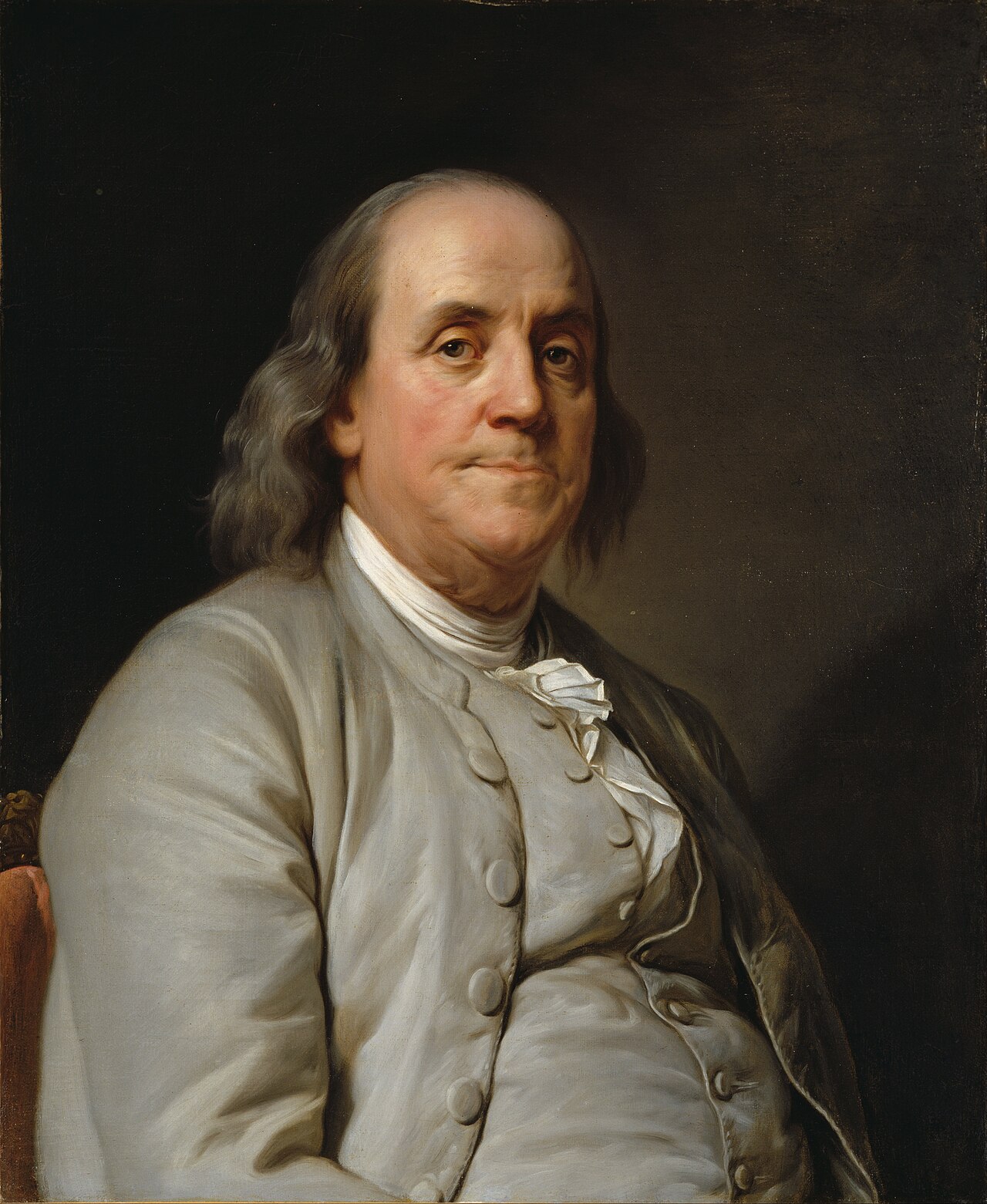
In the 84 years that he lived, from 1706-90, the following is a non-exhaustive list of inventions/experiments/topics that Benjamin Franklin dabbled in:
- Positive and negative electrical charge terminology
- Hypothesis that lightning is electricity
- Kite experiment on atmospheric electricity
- Lightning rod
- Lightning-protection systems for buildings
- Idea of electrical grounding,
- Concept of capacitors and batteries
- Observation that storms can travel in a direction different from the local wind
- Mapping/charting of the Gulf Stream
- Use of ocean temperature to identify currents
- Franklin–Hadley evaporative-cooling experiment
- Explanation of perspiration as evaporative cooling
- Explanation of the cooling effect of moving air
- Observation that oil films can calm waves
- Pennsylvania Fireplace / Franklin stove
- Investigation of chimney draught / Analysis of causes of smoky chimneys
- Bifocal spectacles
- Flexible urinary catheter
- Swimming hand paddles/fins
- Glass armonica
- Mechanical long-reach/grabber device
- Multipurpose library chair
- Systematic measurement of postal-road distances, Postal-route optimization
- Distribution of newspapers through the postal system
- Observations linking lead exposure to illness
- Statistical analysis of smallpox mortality
- Advocacy of ventilation for health
- Analysis of relationships between land availability, marriage and population growth
- Observations on deforestation and local climate
- Studies of cargo distribution and ship stability
- Founding and development of the American Philosophical Society
- Library Company of Philadelphia / subscription-library model
- University of Pennsylvania
- Pennsylvania Hospital
And while doing all of this, he also managed to be the only person to sign all four instrumental documents of the American Revolution – The Declaration of Independence (which he edited for Jefferson), the alliance with France (which he negotiated as the Chief Rep of Congress in Paris), the Peace Accord with England, and the American Constitution.
While reading Walter Isaacson’s ‘Benjamin Franklin; An American Life’, I was amazed at the number of European luminaries he rubbed shoulders with. The list is almost like a Who’s Who of the 18th century – David Hume, Adam Smith, James Watt, Edmund Burke, William Pitt the Elder (and Younger), Joseph Priestley, Erasmus Darwin (the grandfather of the famous Darwin) James Boswell, Voltaire, Lavoisier, Laplace, Leclerc, Lafayette, Louis XVI, Marie Antoinette, the Montgolfier brothers, Casanova, Alessandro Volta and so many more.
What makes Franklin a lovable figure for me was the fact that he was a self-made man. He made his fortunes through the printing press industry and sheer entrepreneurship. But as Isaacson points out, the century following his death saw the rise of the Romantics who had no patience for such men as Franklin:
This Age of Enlightenment, however, was being replaced in the early 1800s by a literary era that valued romanticism more than rationality. With the shift came a profound reversal, especially among those of presumed higher sensibilities, in attitudes toward Franklin. The romantics admired not reason and intellect but deep emotion, subjective sensibility, and imagination. They exalted the heroic and the mystical rather than tolerance and rationality. Their haughty criticisms decimated the reputations of Franklin, Voltaire, Swift, and other Enlightenment thinkers.
The great romantic poet John Keats was among the many who assaulted Franklin for his lowly sensibilities. He was, Keats wrote his brother in 1818, “full of mean and thrifty maxims” and a “not sublime man.” Keats’s friend and early publisher, the poet and editor Leigh Hunt, heaped scorn on Franklin’s “scoundrel maxims” and charged that he was “at the head of those who think that man lives by bread alone.” He had “few passions and no imagination,” Leigh’s indictment continued, and he encouraged mankind to a “love of wealth” that was stripped of “higher callings” or of “heart and soul.” Along these lines, Thomas Carlyle, the Scottish critic so in love with romantic heroism, scorned Franklin as “the father of all Yankees,” which was perhaps not as denigrating as Carlyle meant it to be.
The Apple TV series on his stint in Paris was disappointing. Despite Michael Douglas playing Franklin, the series had a dark, gloomy feel and failed to capture the essence of Franklin’s happening time in Paris.
Discover more from Manish Mohandas
Subscribe to get the latest posts sent to your email.
