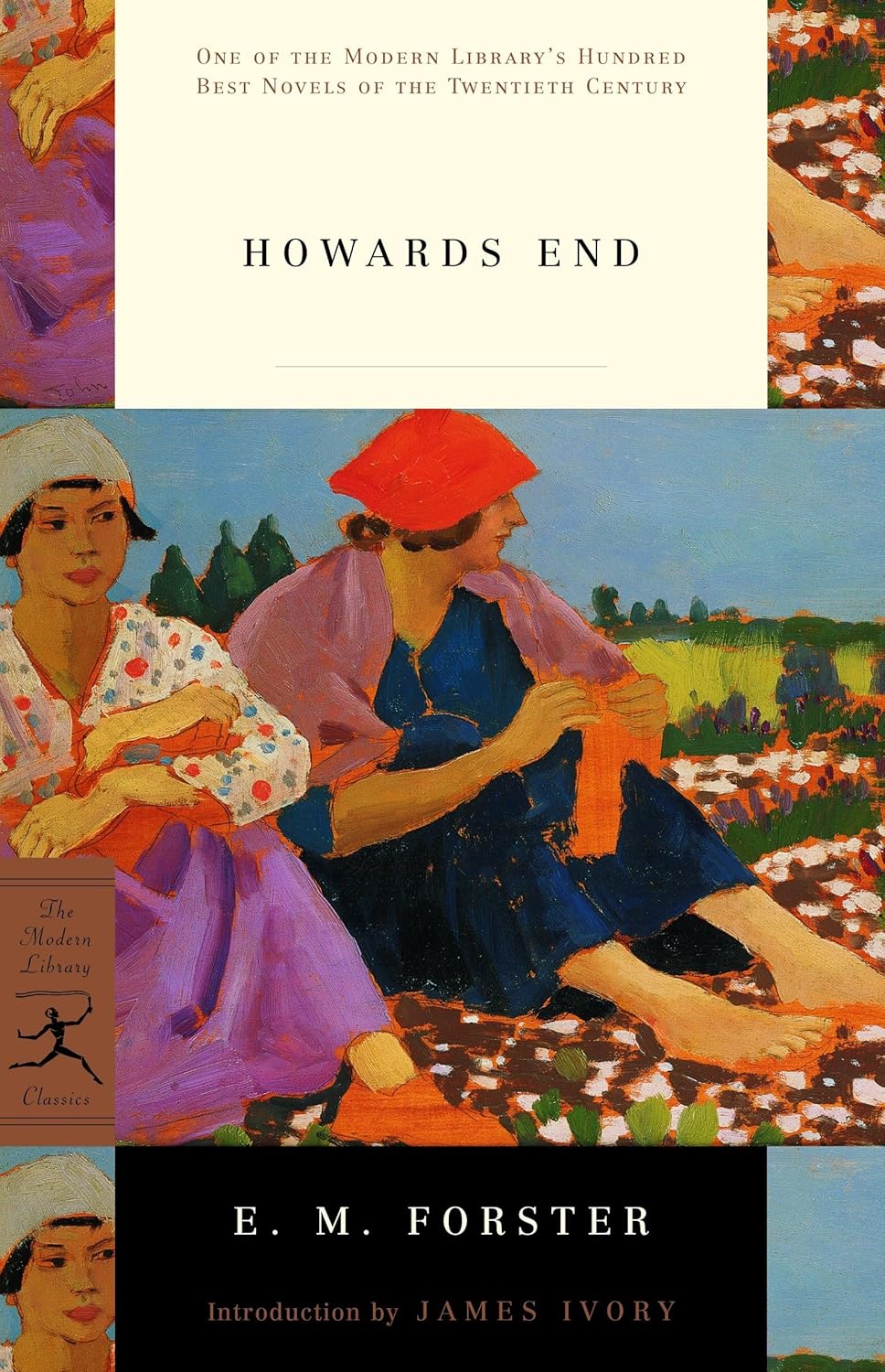
Forster should be more widely read. After having finished ‘A Passage to India’, ‘A Room with a View’ and now ‘Howards End’, I can confidently say that he’s one of the sharpest chroniclers of social relationships in the late Victorian and Edwardian era.
Howards End is firmly rooted in the Edwardian era where the three families around which the book revolves represent the Industrial class of wealth (the Wilcox’s), the heirs to a tradition in which ideas. knowledge and culture reigned (the Schlegel’s) and finally the ones that missed the bus and were bewildered by the changes afoot (the Basts).
There’s a poignant scene where Bast, after having another soul-sucking, miserable day in office, sits in his dingy apartment and attempts to read John Ruskin’s description of Venice and in the attempt wonders how disconnected his world is from the one Ruskin is describing. It’s a devastating scene that captures Bast’s yearning for a richer intellectual life and the cruel barriers that prevent him from attaining it.
And the voice in the gondola rolled on, piping melodiously of Effort and Self-Sacrifice, full of high purpose, full of beauty, full even of sympathy and the love of men, yet somehow eluding all that was actual and insistent in Leonard’s life. For it was the voice of one who had never been dirty or hungry, and had not guessed successfully what dirt and hunger are.
I’ve always encouraged everyone to have an intellectual life -one that is totally disconnected from the labours of our day. That life can act as a safe refuge from the drudgery of the daily grind. The engagement with ideas of writers and thinkers on topics that may seemingly appear to be unrelated to the concerns of our day-to-day lives can in a strange way provide succour and add meaning to life.
Zena Hitz’s ‘The Catherine Project’ and Anna Gat’s ‘Interintellect’ are thriving online communities around precisely this ideal. My own writings have been a feeble attempt to further this agenda. Hitz’s Lost in Thought: The Hidden Pleasures of an Intellectual Life is a good primer on this topic.
Yet Forster here exposes the limits of this vision. The pursuit of culture for someone struggling to make ends meet can be cruel. The academician Arun Kumar, in yesterdays Indian Express argued against this line of thinking in an Op-Ed titled ‘The Worker-Intellectual we refuse to recognise’. (He has a book out this month that “explores the world of Indian workers & conceptualises a non-working history of working lives”)
On the unfairness of the markets:
Looking back on the past six months, Margaret realized the chaotic nature of our daily life, and its difference from the orderly sequence that has been fabricated by historians. Actual life is full of false clues and signposts that lead nowhere. With infinite effort we nerve ourselves for a crisis that never comes. The most successful career must show a waste of strength that might have removed mountains, and the most unsuccessful is not that of a man who is taken unprepared, but of him who has prepared and is never taken. On a tragedy of that kind our national morality is duly silent. It assumes that preparation against danger is in itself a good, and that men, like nations, are the better for staggering through life fully armed. The tragedy of preparedness has scarcely been handled, save by the Greeks. Life is indeed dangerous, but not in the way morality would have us believe. It is indeed unmanageable, but the essence of it is not a battle. It is unmanageable because it is a romance, and its essence is romantic beauty.
The book was adapted by Ivory-Merchant with a star-studded cast that included Antony Hopkins, Emma Thompson and Helena Bonham Carter. I liked it. The BBC’s 4-episode adaptation also did justice to Forster’s genius.
Discover more from Manish Mohandas
Subscribe to get the latest posts sent to your email.

2 thoughts on “Forster’s ‘Howards End’ and the Intellectual Life”