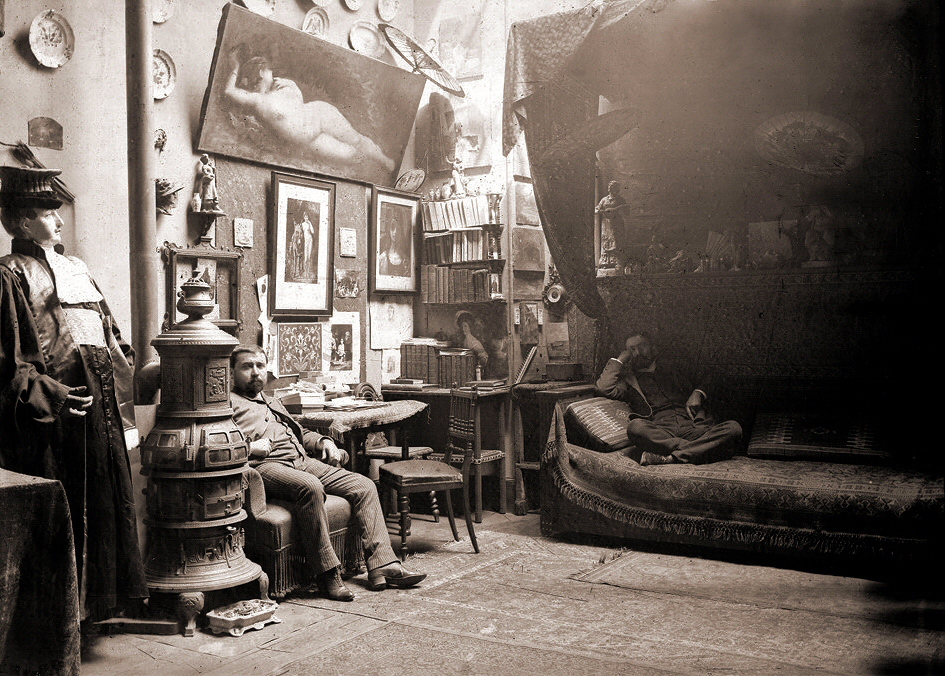
The struggling, misunderstood artist, aloof from the petty insecurities of the middle class and disdainful of wealth, is probably one of the most recognisable and done-to-death tropes in art, literature and popular culture. Such ‘artists’ even have a name – bohemians.
David Weir in his ‘A Very Short Introduction‘ to the topic defines them succinctly;
Bohemians are urban gypsies, or gypsy-artists, moving about from one derelict neighborhood to another, nourished only by their dreams and their hatred of bourgeois society, living wherever they can—a garret, a basement, an unheated studio—provided the rent is cheap and the morals are loose. That, at least, is the prevailing myth, which started in the nineteenth century when Romantic writers such as George Sand (Amantine Lucile Aurore Dupin) compared poets and artists to vagabonds from Bohemia, the supposed home of the Romany people once known by the racist term gypsy (who did not originate in Egypt, as the name “gypsy” suggests, but India)
Paris, from the time of the French Revolution until the mid-1960s, was in a constant state of flux. The transformations the city experienced during the nineteenth century were profound, encompassing society (the rise of the bourgeoisie), politics (the growth of republican governance) and economics (the rise of capitalism). The decline of royal patronage meant that artists, too, had to find their footing in this bewildering milieu. While the bourgeoisie were mocked for their desire for stability and security, bohemian artists revelled in their passion for individual liberty.
Perhaps bohemians belong to a culture first and a class second, and the bourgeoisie to class first and culture second. But however the relationship between the two is understood, the categories “bohemian” and “bourgeoisie” condition one another in various ways. Is “bohemian” the name for the low social stage through which avantgarde culture passes on the way to bourgeois respectability? Perhaps, but the inverse of that dynamic also occurs, when the respectable, cultured bourgeoisie seeks acceptance into the social world of the bohemian.
The impact of Bohemianism on urban geography has also been substantial. While bohemians are often considered to be unmoored, in reality, most have been tied to specific urban centres. In Paris, Montmartre, Montparnasse and the Latin Quarter; Greenwich Village in New York; Hauz Khas Village (atleast the 1980s avatar) in Delhi, and Schwabing in Munich are some of the most recognisable urban spaces associated with bohemianism. Hashish, weed and other psychotropic substances have also allowed bohemians to ‘travel’ without having to step outside their homes (or even get off the couch), a concept made ‘cool’ by Baudelaire in his writings.
If theory can explain so much, does it mean that the itinerant rebel is not so unconventional after all? Are bohemians merely mimicking an established ideal of rebellion? Is this all mimesis at play?
This page: ‘Artists and their Bohemian Ateliers‘ has some visually stunning photographs of artists in their studios from the period that defined the Bohemians.
Discover more from Manish Mohandas
Subscribe to get the latest posts sent to your email.
