
Until yesterday, the only Eden that I knew was Antony Eden, the British PM remembered for the disastrous Suez Crisis of 1956. Apparently, Lord Auckland, the Governor General of India from 1836-42 was an ancestor of Eden. When Lord Auckland was posted in India, he was accompanied by his sister Emily Eden who ended up travelling across India with her brother. Her paintings from this period were compiled and published as “Portraits of the Princes and People of India’. These lithographs are on display at the DAG and my visit yesterday after office enlightened me on this trivia. (The entire catalogue of artworks can be viewed at DAG’s page)
The Auckland Circus Gardens of Calcutta was renamed as the Eden Gardens in honour of these siblings in 1841.
The most striking portrait was the one of Maharaja Ranjit Singh. All the images I’ve seen of him are close-up shots that feature his small-pox-destroyed-eye, flowing beard and regal vibe. But the Ranjit Singh drawn by Eden was one of a king past his prime, weakened by age yet in command of his empire. (Lord Auckland’s visit to Lahore was part of Britain’s outreach to checkmate Russia in the Great Game that was unfolding in Central Asia. The First Anglo-Sikh War broke out soon after Ranjit SIngh’s death and during Auckland’s tenure.)
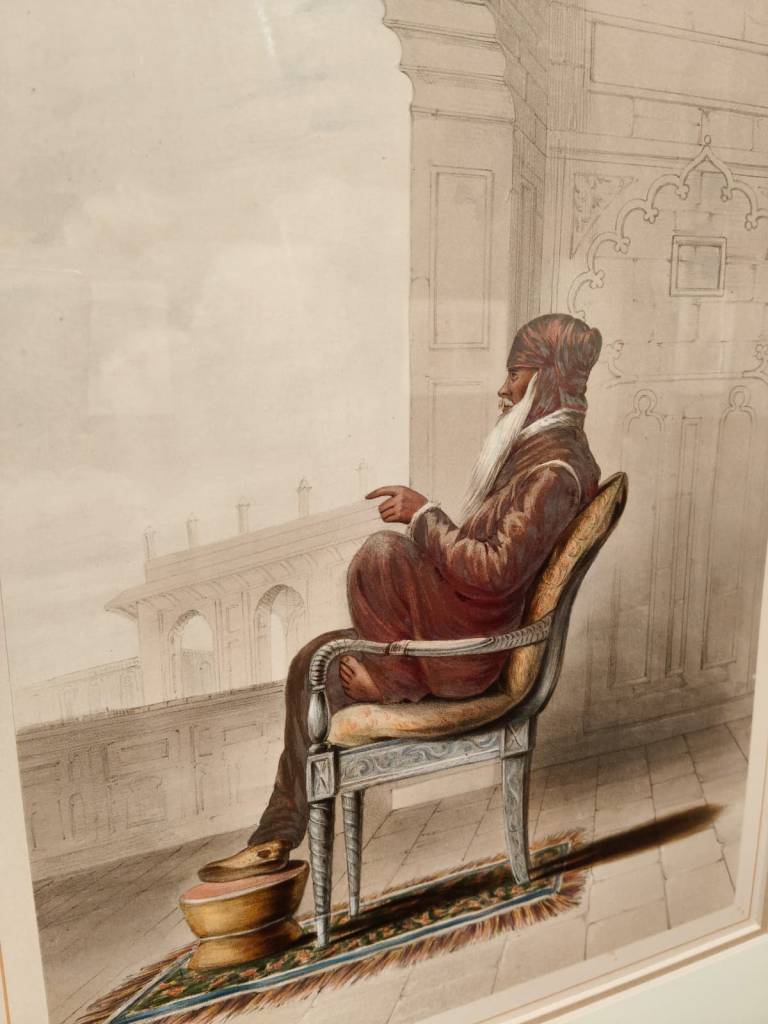
The late MAHA RAJA RUNJEET SINGH.
The Print represents this well-known Chieftain, in his usual attitude and dress, during his interviews with the Governor General of India, in November and December, 1838. He retained a perfect simplicity, or rather plainness of appearance, while his Chiefs and Courtiers around him wore the most brilliant draperies, and a rich profusion of jewels. His manners were always quiet, and he spoke chiefly in endless desultory questions; among which, as if without premeditation, or particular interest in it, he introduced the one which was of importance to him. At the time at which this likeness was taken, he was partially paralized, and he said but few words to his attendants; guiding the order of his Durbar or Court, and even the movements of his troops, mainly by signs made with his forefinger, the motions of which were watched by a number of his confidential personal servants, who remained always near him. He had a curious and constant trick, while sitting and engaged in conversation, of raising one of his legs under him on the chair, which he used in compliance with the customs of his European visitors, and then pulling off the stocking from that foot. He had the use only of one eye, which age, and a hard life of exposure and excesses, had dimmed at the period now spoken of, but it still retained the traces of the vigour and penetration from which he was remarkable.


Discover more from Manish Mohandas
Subscribe to get the latest posts sent to your email.
