
Thanks to being the resident Social Science teacher at home, I got to read the content on Shivaji in the Class VIII NCERT textbook. The chapter made random references to Afzal Khan, Shivaiji’s raid of Surat, his defeat by Jai Singh, the famous escape from Agra, his coronation, Tarabai, Thanjavur etc. The mandatory reference to him being the ‘first Hindu king to rally for Swaraj’ was duly mentioned too. Just like any student being forced to study such material, I too failed to gain an appreciation of him. My curiosity got piqued and I decided to dig up more information about him.
I began with Ritesh Deshmukh’s 2026 movie – Raja Shivaji. Terrible. I was also worried whether from now on, the image of Shivaji in my mind, would forever be Ritesh Deshmnukh’s baby face.
Vaibhav Purandare’s biography of Shivaji was a quick read. James Laine’s work Shivaji: Hindu King in Islamic India analysed the myth making that went into the Shivaji project. I also flipped through Govind Pansare’s ‘Who was Shivaji’ – a translation of his Marathi bestseller Shivaji Kon Hota (Pansare was shot dead in Kolhapur in 2015 at the age of 81 for his pro-rationalist views).
While Shivaji’s role in our history has reached mythical proportions in Maharashtra, I now have no doubts that he was indeed a hero in the classical sense. His military achievements, daring raids, absence of overt bigotry and political astuteness made him a terror for his adversaries.
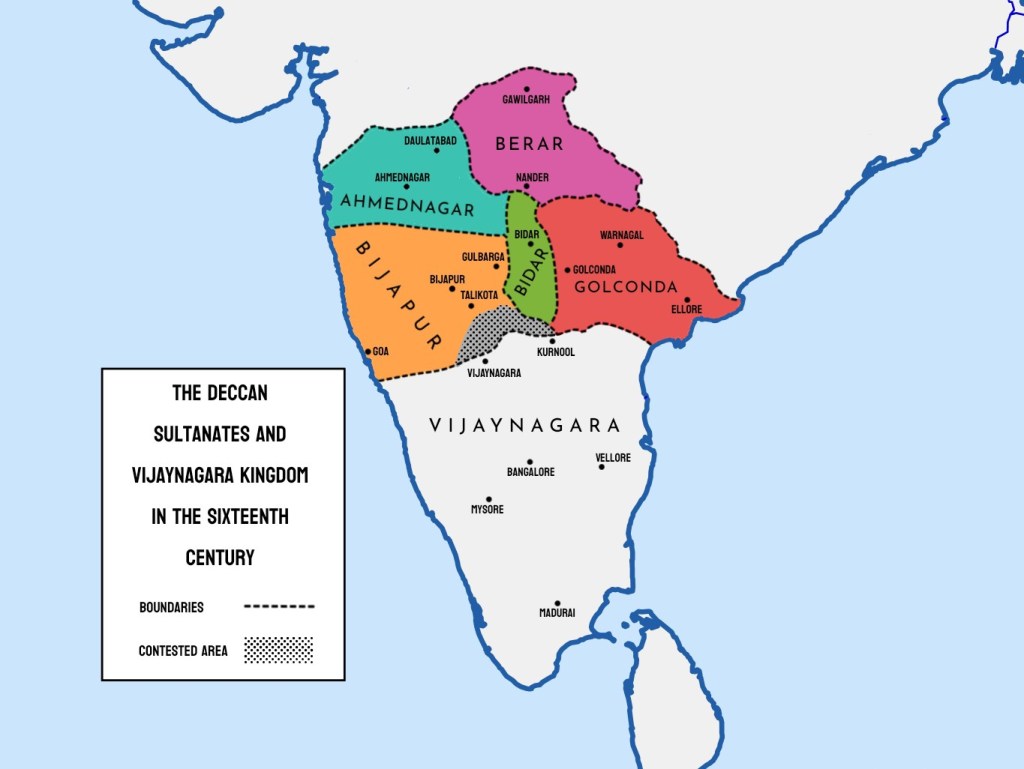
The Deccan during his lifetime was splintered between the Adil Shahs of Bijapur, Qutub Shahis of Golconda, Nizam Shahis of Ahmednagar and the Imad Shahis of Berar. By the mid-16th century, the Mughals soon became the force reckon with in the North. It was in this milieu that the Marathas operated. Depending on the political winds, the Marathas were recruited by various rulers, and their flexibility was one of the reasons for their longevity.
The legend of Shivaji definitely had to do with the dramatic incidents of his life. There are quite a few to list:
- His killing of Afzal Khan (portrayed by Sanjay Dutt in the 2026 movie),
- His raid of his boyhood home when it was occupied by Shaista Khan (Aurangzeb’s uncle and Mumtaz Mahal’s brother)
- His daring escape from Agra in a fruit basket thus foiling Aurangzeb’s attempt to assassinate him
- The twin raids of Surat – India’s biggest port and the point of embarkment for Haj
- Retaking all the 23 forts he surrendered to the Mughals within a span of 4 months. (12 of his forts are a part of the Maratha Military Landscapes of India – tagged as a UNESCO Heritage Site in 2025)
- The navy that he built with Portuguese support
There are many more but any figure that pulled off all these over a lifetime of being on the run becomes the perfect candidate for myths to be built around. The tragedy of our society is that when heroes become cultural and religious icons, the space to appreciate, critically engage and evaluate them every few decades, keeps shrinking.
Shivaji’s conversion into a national icon was a key project of numerous nationalists such as Ranade and Tilak. Again these too were projects. Through Lane, I learnt that the anthropologist Iravati Karve had famously declared: “I have found a new definition of Maharashtra: the land of whose people go to Pandharpur for pilgrimage”.
ChatGPT explains:
For Iravati Karve, Pandharpur represented Maharashtra in miniature. The pilgrimage to Vitthal brought together people from across the region, turning Maharashtra into a shared sacred geography, while the abhangs of Dnyaneshwar, Namdev, Eknath and Tukaram gave this community a common Marathi cultural language. The Varkari tradition also brought different castes and occupations into a shared devotional world, even if it did not erase social inequalities. Thus, if Shivaji came to embody Maharashtra’s political identity, Pandharpur embodied its deeper cultural, linguistic and devotional identity.
Shivaji had no links with this tradition but was a staunch follower of the Goddess Bhawani. According to Lane:
Even during the nationalist movement, when the moderate reformer Justice Ranade championed the idea of the Maratha kingdom of Shivaji as a precursor to a modem independent India and linked Shivaji to the “protestant movement” of Maharashtra, the more prominent nationalist and neo-traditionalist, Lokmanya Tilak, alongside calls for a celebration of the life of Shivaji, chose to develop a popular festi-val to the god Ganesha (a god in no particular way associated with Shivaji) rather than champion either the Varkari tradition or the goddess Bhavani.
Thus there are reasons to mention Bhavani, Ganesha, Jnaneshvar, Ramdas, Shahaji, Shivaji, and Tilak in a history of Maharashtra, but there are no obvious reasons to link them in a directly linear narrative. Likewise, there are reasons to refer to Maharashtra geographically as a land of Marathi speakers who recognize a variety of sacred geographies of Maharashtra that include Shaiva shrines, Tuljapur, the Ganesh sites, and shrines to Dattatreya and Parashurama, as well as group of saints’ towns (Alandi, Dehu, Paithan) connected by pilgrim age routes to Pandharpur. But the modern narrative that so easily weds the story of Shivaji to a Maharashtrian sacred geography centered at Pandharpur is anachronistic.
Discover more from Manish Mohandas
Subscribe to get the latest posts sent to your email.

One thought on “The Remarkable Shivaji”