
In popular imagination, the Allied invasion of continental Europe is dominated by the Normandy Landings. The opening amphibious landing scene in Spielberg’s ‘Saving Private Ryan’ and the Cold War narrative of the joint Anglo-American thrust to free Europe and clear the road to Berlin have both contributed to this narrative. The truth was that months before June 1944, the Allied forces had established a firm foothold in Europe and that was by fighting their way upwards from distant Sicily and then moving northwards in a bloody campaign that culminated in the liberation of Rome which few today realize took place two days before the Normandy landings.
Sicily fell in August 1943, the Salerno landings happened in September, Naples fell the same month and finally Rome was liberated in June 1944 after one of the bloodiest battles of the War – Monte Cassino. In India, few today are aware of the significant role played by Indian troops in the Italian Campaign. Units from the British Indian Army including Gurkha battalions, Sikh regiments, and the Rajputana Rifles were deeply involved in some of the fiercest fighting around the Battle of Monte Cassino. Indian and Gurkha troops, particularly from the 4th Indian Division, carried out extraordinarily difficult mountain assaults and suffered heavy casualties during the attempts to break the German Gustav Line. The Sikh character in Michael Ondaatje’s ‘The English Patient’ has probably done the most to evoke the memory of thousands of Indian soldiers who fought and died in a distant European war under the British Empire
Normal Lewis, a British officer who spent a few months in liberated Naples, has written one of the definitive accounts of Naples during that period. His Naples ’44 An Intelligence Officer in the Italian Labyrinth was a wonderful read which covered not just the historical context but also showed what everyday life in Naples during those months were. Women were raped, prostitution was rampant, and almost every household faced hunger. The thriving black market for Allied military rations, the barter (often through sex), the booby-trapped buildings, venereal disease, desperation, and the constant struggle for food formed the backdrop to daily life.
Rape is a fairly everyday event in this part of the world, and is not necessarily a serious business for the victim. Peasant girls in some of the big estates are raped by their overseers as a matter of course every day of the week. It is said that a local count provides members of his work force to any male guest who visits the latifundia for a riding or shooting holiday, his sole stipulation being not to spoil them with gifts of money. Concealment of what has happened is what matters, to avoid a personal slump in value in the sexual market.
In one harrowing section, Lewis while dining in a restaurant sees a bunch of girls groping their way inside. He learns that they were blind students from an orphanage who during a halfday outing, gets lured by the smell of food. The scene turns heartbreaking as the girls are led away, wailing in hunger without having received even a morsel to eat.
Lattarullo explained that these little girls were from an orphanage on the Vomero, where he had heard – and he made a face – conditions were very bad. They had been brought down here, he found out, on a halfday’s outing by an attendant who seemed unable or unwilling to stop them from being lured away by the smell of food. The experience changed my outlook. Until now I had clung to the comforting belief that human beings eventually come to terms with pain and sorrow. Now I understood I was wrong, and like Paul I suffered a conversion – but to pessimism. These little girls, any one of whom could be my daughter, came into the restaurant weeping, and they were weeping when they were led away. I knew that, condemned to everlasting darkness, hunger and loss, they would weep on incessantly. They would never recover from their pain, and I would never recover from the memory of it.
On the common sight of prostitution in the streets:
Here a row of ladies sat at intervals of about a yard with their backs to the wall. These women were dressed in their street clothes, and had the ordinary well-washed respectable shopping and gossiping faces of working-class housewives. By the side of each woman stood a small pile of tins, and it soon became clear that it was possible to make love to any one of them in this very public place by adding another tin to the pile. The women kept absolutely still, they said nothing, and their faces were as empty of expression as graven images. They might have been selling fish, except that this place lacked the excitement of a fish market. There was no soliciting, no suggestion, no enticement, not even the discreetest and most accidental display of flesh. The boldest of the soldiers had pushed themselves, tins in hand, to the front, but now, faced with these matter-of-fact family-providers driven here by empty larders, they seemed to flag. Once again reality had betrayed the dream, and the air fell limp. There was some sheepish laughter, jokes that fell flat, and a visible tendency to slip quietly away. One soldier, a little tipsy, and egged on constantly by his friends, finally put down his tin of rations at a woman’s side, unbuttoned and lowered himself on her. A perfunctory jogging of the haunches began and came quickly to an end. A moment later he was on his feet and buttoning up again. It had been something to get over as soon as possible. He might have been submitting to field punishment rather than the act of love.
A fortnight after joining his mission in Naples, a pretty, malnourished young girl whom he had encountered a few days before, stood before him trembling and handed over a letter with this note:
‘Sir, I noticed when your honour was good enough to call that from the way you looked at my daughter she made a good impression on you. This girl, as you know, has no mother, and she hasn’t eaten for four days. Being out of work, I can’t feed my family. If you could arrange to give her a good square meal once a day, I’d be quite happy for her to stay, and perhaps we could come to some mutually satisfactory understanding in due course.’
The father was helplessly offering to prostitute his own daughter to keep her from starving.
Observations on some quirky cultural practices:
I noticed that Don Enrico, enthroned in his wicker armchair in a position in which he could keep under observation every person who entered or left the hotel, occasionally groped in his pocket to touch his testicles on the appearance of a stranger. This, Don Ubaldo explained to me, was a precaution – commonplace in the South, but frequently practised by Northerners, including Mussolini himself – to ward off the evil eye.
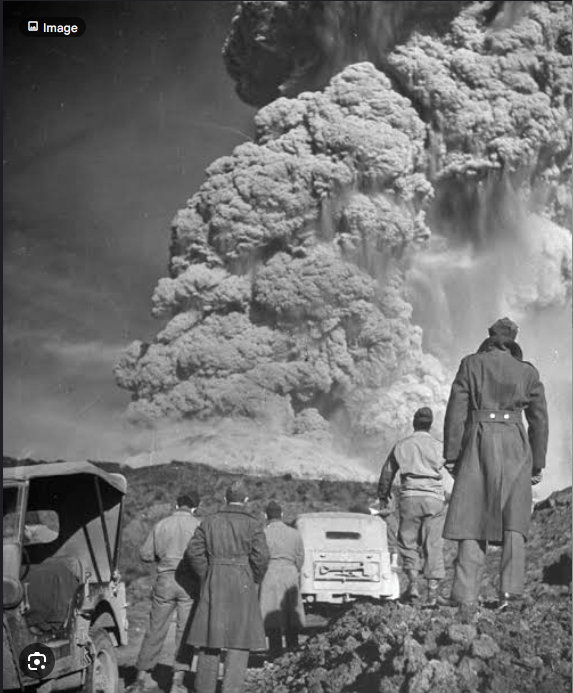
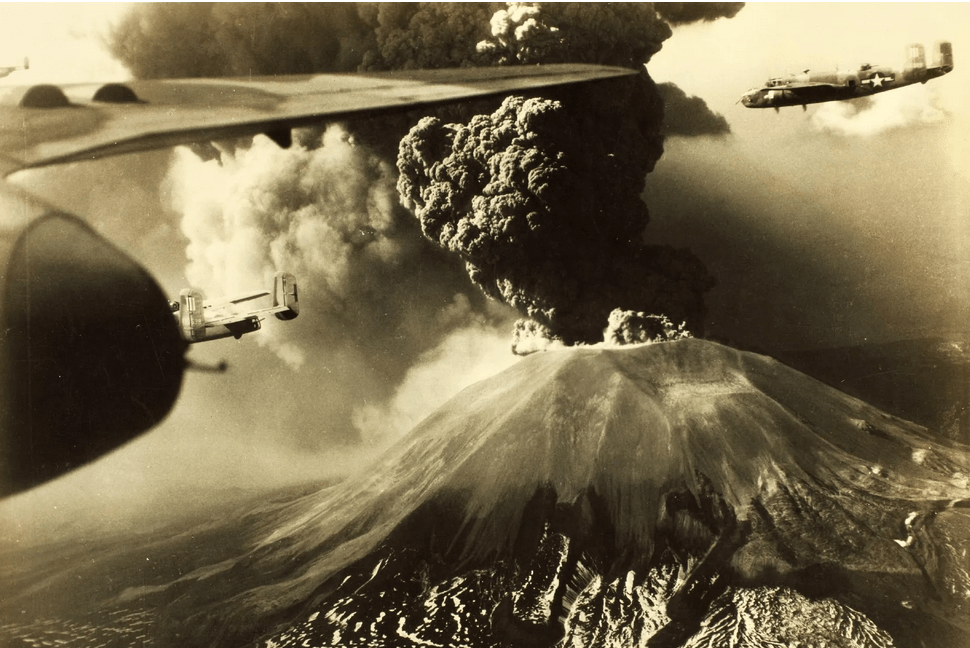
And to add to the terror and surrealism of the period, Vesuvius also erupts in March 1944 causing widespread destruction!
Discover more from Manish Mohandas
Subscribe to get the latest posts sent to your email.

2 thoughts on “The Forgotten ‘Battle for Italy’ and Naples in 1944”