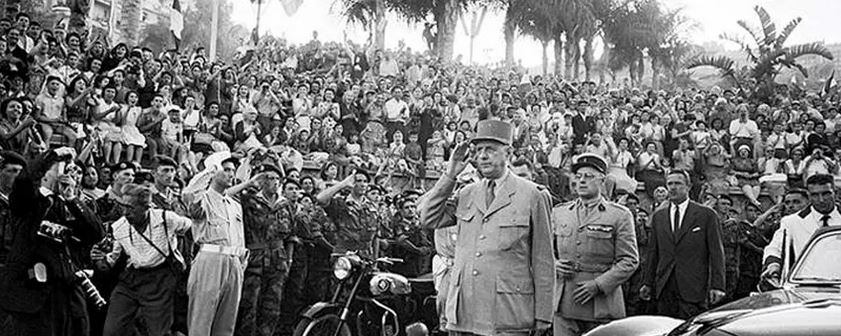
Alistair Horne’s magisterial ‘A Savage War of Peace: Algeria 1954-62’ is a masterpiece and has been a gripping read so far.
The Algerians never had a national identity until the beginning of their discontent with the French. The land was ruled by the Carthaginians for seven centuries who were then replaced by the Romans, the Byzantines, the Arabs, the Spaniards and the Turks.
Following France’s invasion of Algeria in 1830, the country gradually became a settler colony, with large-scale European migration. (In India, the British never settled in large numbers. The British came to rule and their plan was to administer and move the wealth overseas to Britain). In settler colonies such as Algeria, the intent was to promote large scale immigration and bring in Europeans to manage the land. In addition to the French, large numbers of Spaniards, Italians, and Maltese also arrived. In 1917, only one in five Europeans was of French origin. The European settlers known as Pied-Noirs, were granted privileged access to land, businesses, and governance.
The grievances of the Algerians were genuine and like in all colonies, driven by the racism and shortsightedness of the colonial power. In Algeria, Muslims were French “subjects”, but not French “citizens”. They were subject to Islamic law, as opposed to French law. While this may have been designed as a cultural and religious protection, it backfired. A Muslim desiring to adopt French citizenship could only do so by relinquishing his religious rights, thus committing an act of apostasy. On the other hand, Jews had no such rules applied to them.
France’s capitulation to Hitler in the Second World War was the beginning of the end of their supremacy. The Post-World War II era was one of decolonization movements across Asia and Africa. The French loss in Dien Bien Phu to the Vietnamese was the proverbial nail in the coffin of French supremacy. The French exit from Morocco and Tunisia increased the clamour for a free Algeria. Nasser’s nationalisation of the Suez and the botched-up Suez operation launched by Britain and France marked the end of British supremacy and heralded the world where the Cold War dynamic would henceforth rule. All this added fuel to the burgeoning Algerian nationalist movement.
On the regular day-to-day interactions between the Pied Noirs and the locals:
Solid friendships could exist between the two but seldom matured into anything more intimate because, says Jacques Soustelle, ethnologist and future governor-general: “the traditional status of the Muslim woman, recluse and veiled, hindered families from getting together, from households entertaining each other.” There was a fundamental divergence of orientations: when the pied noir went on holiday he made for the beach, and instinctively he gazed out over the Mediterranean towards Europe. In contrast, the Arab or Kabyle would head for the cool verdure of the mountains or the desert oases; he looked inland, towards the land-bound heart of Africa.
Albert Camus, who was born in Algeria, was probably the best chronicler of the pied-noir perspectives. Growing up in working-class Algiers, he captured the uneasy coexistence between Europeans and native Algerians in The Outsider (L’Étranger). The protagonist Meursault’s indifference to social expectations mirrored the disconnection many settlers felt from both metropolitan France and the Algerian majority. Through his fiction and essays, Camus portrayed a world where colonial privilege coexisted with hardship, and where identities were shaped by both belonging and estrangement. Describing the cities of Algeria, Camus writes
These are cities without a past. They are cities without abandon, without tenderness. In the hours of boredom which are those of the siesta, the sadness there is implacable and without melancholy.… These cities offer nothing to reflection and everything to passion.…”
The Front de Libération Nationale (FLN) of Algeria which became the face of the resistance eventually chucked out France. they in turn became one of the fundamental sources of inspiration for the other anti-colonial movement of our generation – the Palestinians.
The FLN served as a revolutionary prototype for the Palestinian liberation struggle, influencing its military strategies, political ideology, and diplomatic engagements. The Algerian model of armed resistance, international solidarity, and anti-colonial struggle deeply shaped the PLA’s development and the broader Palestinian resistance movement and also inspired its most dreaded tactic – terrorism.
Discover more from Manish Mohandas
Subscribe to get the latest posts sent to your email.

You have to review your Humanities degree, I don’t know from where you draw your references and theories, you want to go back and verify your data, there is many places that contain genuine archives bibliothèques of Aix-En Provence in France, like the library of congress in America, the Princeton University Library, by the way Abraham Lincoln had sent two old pistols as gifts for having saved Christians from massacre in Syrie during his exile, see Wikipedia an Fowler, other lecture? The memories the colonel Charles Henry Churchill: The Life of Abdelkader, the ex-Sultan of Algeria, for your knowledge the first prehistoric man in North Africa was discovered by the French paleontologists in the east of Algeria his name is the aterian neolithic period, like the Neanderthal man most of the same age before the sapiens sapiens, and most recent eras the credential diplomatic papers from the kingdom of England, Norway, we can look online and be my guest, and no drama and no gruges just for fun
LikeLike