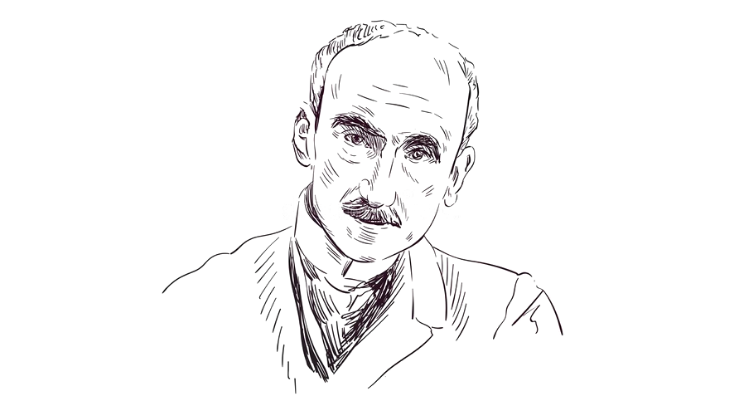
At the height of his fame, Henri Bergson, was not just France’s leading philosopher but also arguably the most popular public intellectual of his age. His lectures were jam-packed and the audience cut across all classes and gender.
Bergson, is most known for his concept of time which he called Durée. For Bergson, the qualitative aspect of time was as important (if not more) as the quantitative aspect to which it was reduced to by physicists and scientists. If the time spent in the arms of your lover feels different from the time spent in a waiting room, it probably has to do with this subjective, qualitative aspect which Bergson called Durée. In Emily Herring’s ‘The Herald of a Restless World’, an accessible biography of Bergson, she writes:
“The first thing I observe is that I pass from one state to another. I am hot or cold, I am happy or sad, I work or do nothing. I look at what is around me or think about something else.… I change continuously.” However, continued Bergson, “even this does not say enough.” The change we sense in ourselves is not as clear-cut as the words we use to describe it might suggest. The “change in question is far more radical than one might have at first believed.” The very language we use tricks us into conceiving our existence as a string of separate events, with a clear-cut “before” and “after.” It is hard to resist separating moments in our lived experience from one another and treating them as though each has a clear beginning and ending: “I was hungry, but then I ate and I was no longer hungry,” or “I used to be a child, and now I am an adult.” But those who are attentive to what is really happening in their inner life will see that the changes occurring within their consciousness are not merely transitions between otherwise stable states; rather, the states themselves are “being modified at each moment.”
If… we remain absolutely within ourselves, we feel that something expands without any divisions, just like the progression of a melody. Our inner life, from beginning to end, is thus an indivisible continuity, and this is what I call our durée. It is succession, but succession without numerical and distinct multiplicity, that is, pure succession.
Durée is the continuous progression of the past, gnawing into the future and swelling up as it advances.… This survival of the past makes it impossible for a consciousness to pass through the same state twice.… As such, our personality constantly sprouts, grows, and matures. Each of its moments is something new added onto what came before.
In a strange twist of fate, Bergson’s theory of time clashed with the theory of the other titan of the age – Albert Einstein, who himself had his own mind bending views on time and space. While lecturing in Paris, Einstein was confronted with Bergson who shared some of his disagreements with Einstein to which the physicist gave a devastating retort: “The time of the philosopher does not exist.”
Einstein was awarded the Nobel for his discovery of the Photo Electric effect and not for his work on relativity. One reason for this was Bergson’s critique of Einstein’s relativity. A more detailed piece on the Einstein-Bergson debate is here.
Bergson himself was later awarded the Nobel for Literature in 1927. And Proust, the man who explored the influence of memory and time in literature like none other, was Bergson’s brother-in-law.
Discover more from Manish Mohandas
Subscribe to get the latest posts sent to your email.
