
Australia today has a population of 27 million and a GDP of $1.7 Trillion. Around 8 million people visit it annually and it’s also a highly sought after destination for skilled migrants.
Australia started off as a penal colony and the first expedition of white settlers (convicts) set foot in Australia only on 26th January 1799. Terra Australis – a 500-page French Graphic novel which I read last month, tells the tale of this expedition.
Australia was claimed for the British by James Cook when he stopped by at Botany Bay in 1700. After the loss of America in 1776, Britain began to realize it needed a penal colony to ‘transport’ its convicts as the national prisons were overflowing. Transportation was a punishment for crimes that didn’t warrant death and even crimes such as theft could land you in a penal colony. The ongoing geopolitical rivalry with France, also created a sense of urgency to lay claim to Australia.
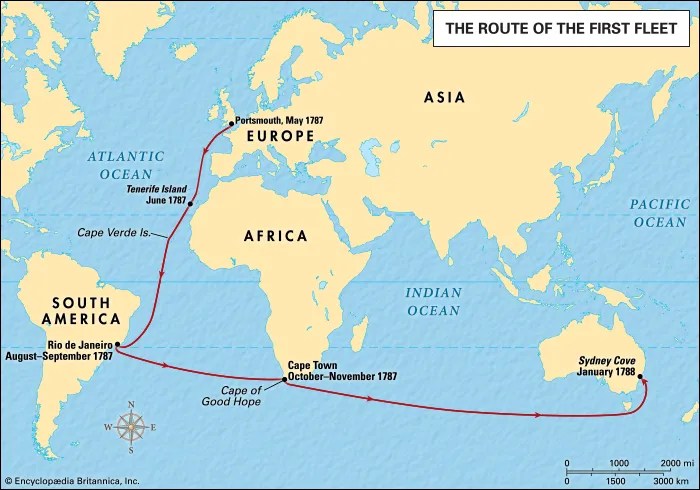
In this backdrop, the first fleet captained by Arthur Philip set sail from Britain on May 1787 and landed in Australia in January 1788. It consisted of 11 ships – 2 naval vessels, three supply vessels and six carrying convicts. The fleet carried 1400 people of which half were convicts, covered 24,000 kilometers and took close to 250 days to cover the voyage. The voyage stopped at Tenerife, Rio de Janeiro and then moved towards Cape Town to catch the westerlies. In Cape Town, the ships were stocked with plants and animals for agriculture in Australia. The voyage was largely a success as not a single ship was lost. It still beats me to imagine that this singe voyage was the first step to making Australia what it is today. Convict transportation ended in 1868 and by then over 150,000 convicts had been moved to Australia!
This first voyage by Captain Philip is also the theme of the 2015 television series ‘Banished’. While the plot was slightly contrived – convicts and soldiers fighting over women (how unsurprising for a series), it also highlighted some of the challenges of establishing a human settlement in a hostile, strange land. The importance of blacksmiths, carpenters, the role of the vicar in providing stability, the fear of the ‘Bush’ – the Australian outback, initial efforts at building literacy, the system of assigning women to the men, the rationing of food etc. were things I learnt from it.
Both the book and the series failed to provide adequate attention to one critical stakeholder in this entire saga – the Aborigines.
Discover more from Manish Mohandas
Subscribe to get the latest posts sent to your email.

3 thoughts on “The First Convict-Voyage to Australia”