During the last thirty years of the 18th century, the most feared adversary of the British was undoubtedly the father-son duo of Mysore – Haider Ail and Tipu Sultan. Looking back, its fascinating to imagine the international influence that the two wielded. The Anglo-Mysore wars were keenly tracked by the French and going the Machiavellian maxim of your enemy’s enemy being your friend, the American revolutionaries were also well informed of Haider Ali’s moves against the British. The Americans even christened one of their warships as Hyder-Ally as a mark of their admiration.
After his father’s death, Tipu took over the reins of the kingdom and dealt with two Governor Generals before his death. The first was Cornwallis who landed in India after his humiliating defeat in Yorktown by the Americans. His successor was Wellesley who after Tipu’s death went on to become the Duke of Wellington and defeat the then scourge of Europe – Napoleon Bonaparte and exiled him to St. Helena. Tipu also sent embassies to the Ottoman sultan and Louis the XIV who ended up losing his head during the French Revolution. What a time to be alive!
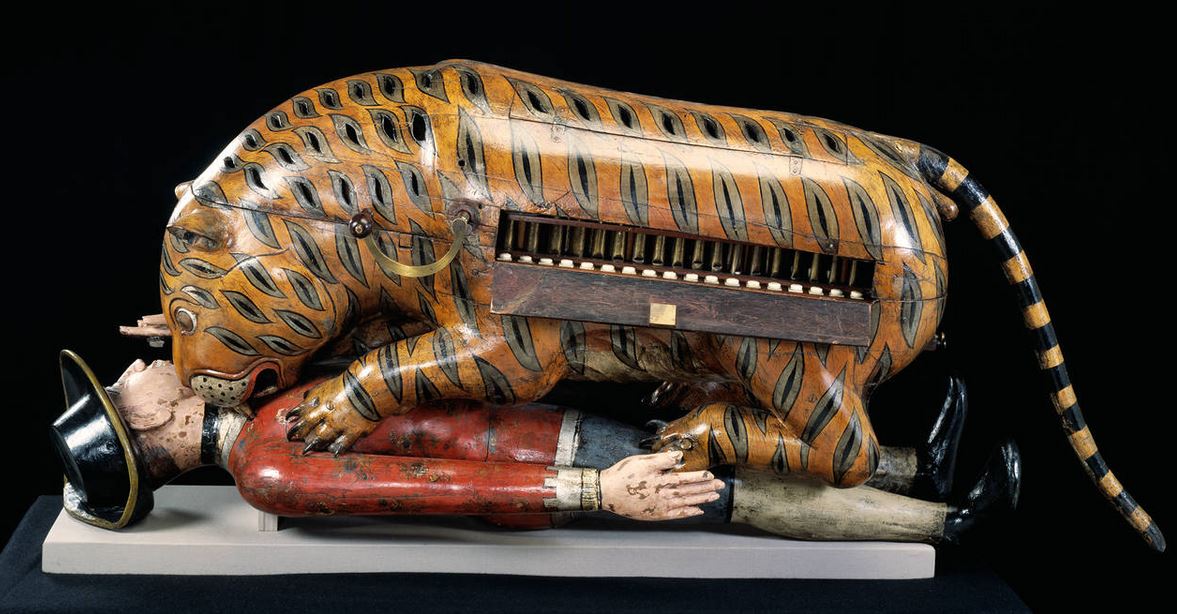
What led me to Tipu this weekend was Tanya James’ Loot – an impressive fictional take on the Indian and French artisans who created the most well-known object possessed by the Sultan – Tipu’s Tiger. Until now, I thought the tiger was a ‘toy’ mauling a Sahib. It’s instead an almost life-size object which opens up to display the intricate mechanism of the organ concealed inside:
The tiger, an almost life-sized wooden semi-automaton, mauls a European soldier lying on his back. Concealed inside the tiger’s body, behind a hinged flap, is an organ which can be operated by turning the handle next to it. This simultaneously makes the man’s arm lift up and down and produces noises intended to imitate his dying moans.
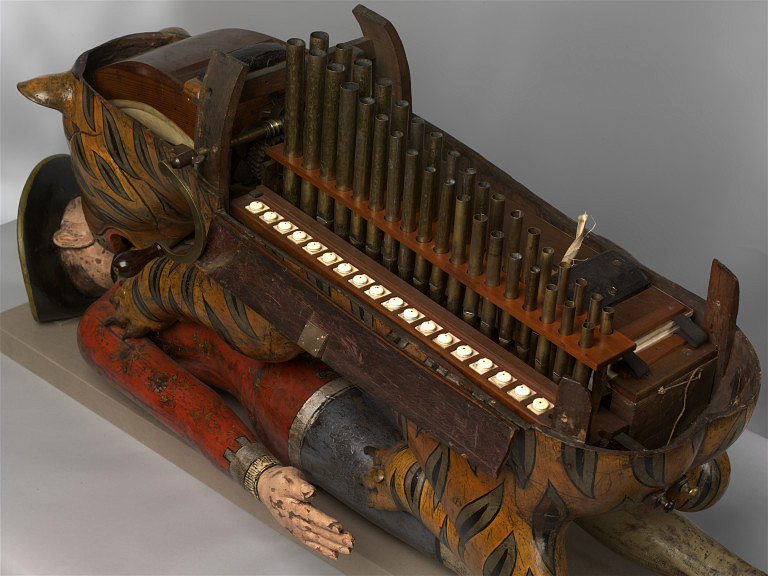
Tipu’s Tiger is currently exhibited in the Victoria and Albert Museum in London and is one of their most intriguing pieces on display. Tipu was curious of the scientific achievements and the discoveries happening in Europe. Thanks to the French presence in Pondicherry, he had a steady stream of articles coming into his possessions – barometers, clocks, watches, metals etc. Tipu’s Tiger is widely believed to have been crafted by a French craftsman. After Tipu’s death in 1799 (he was shot dead resisting a British soldier flicking his necklace while laying grievously injured during the siege), the East India Company looted his palace and distributed his treasures as bounties of war. The tiger ended up in the EIC museum. (Earlier piece on Museums and Repatriation)
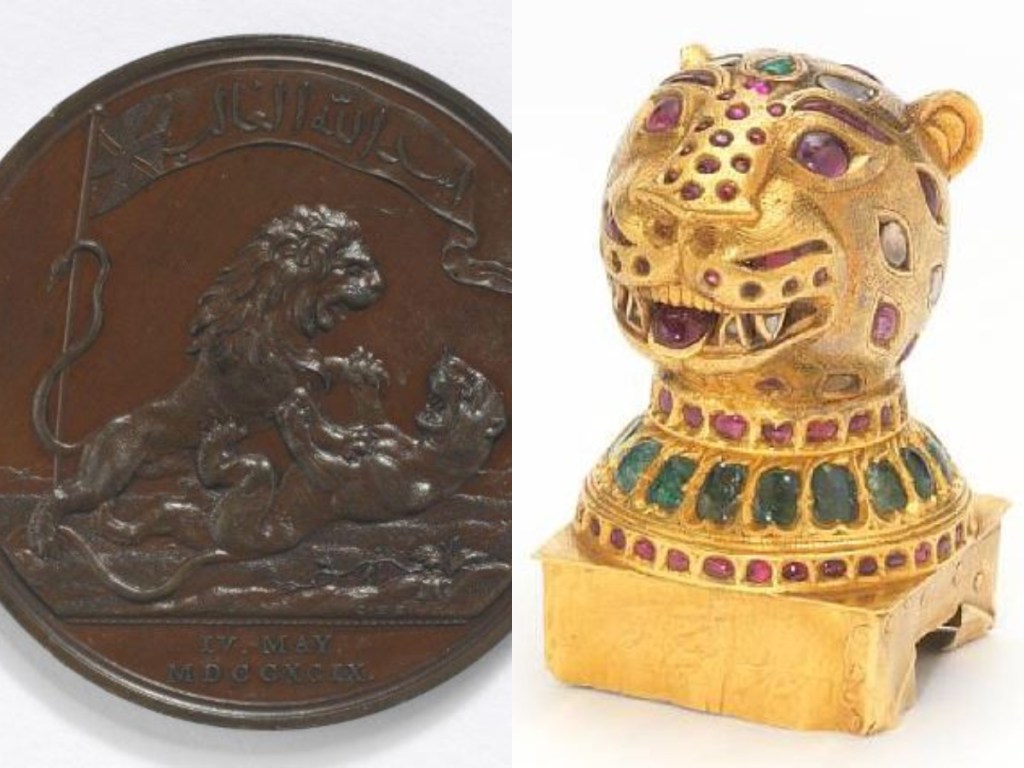
After their victory, every soldier who participated in the siege of Seringapatnam was awarded a medallion. The medal had a lion devouring a tiger. No prizes for guessing what it referred to. The other intriguing object from that era is the head of a tiger from Tipu’s throne which was smashed by overzealous soldiers. While one of them is in Windsor Castle today, the other two are in private collections.
Discover more from Manish Mohandas
Subscribe to get the latest posts sent to your email.

interesting!
LikeLike