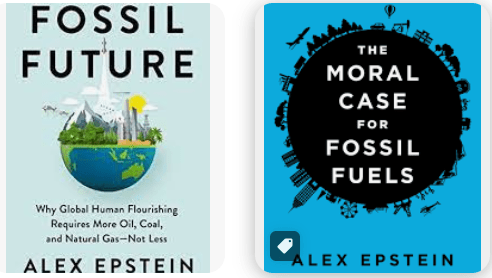
I spent last weekend with Alex Epstein’s 2014 “The Moral Case for Fossil Fuels’ and his recent 2020 work “Fossil Future”. However controversial his defense of fossil fuels may be, I must admit that his whole approach had a convincing ring. With a background in philosophy, Epstein frames the whole debate using the concept of ‘standard of value’.
When we keep ‘Human Flourishing’ as the standard of value, then there is no alternative to fossil fuels. On every indicator, life in general for humans has improved since the Industrial Revolution. However, with billions yet to have access to sufficient energy (According to the International Energy Agency, in 2019, around 789 million people globally did not have access to electricity, and around 3 billion people did not have access to clean cooking facilities), the morality of saying no to fossil fuels (when the alternatives are still unscalable) comes into question.
For the crusaders against fossil fuels, the two standards of value are “Anti-impact” and “Delicate Balance”. The first is the belief that human beings should ideally have no impact on the environment through their actions. The second is the concept that nature has everything set to a perfect balance. (To dispel this idea, imagine living without vaccines, medicines, plumbing or heating or feeding six billion people). Both these arguments get dismantled in the book with sufficient firepower!
The graphic below sums up this moral quandary: “There are no low energy, rich counties”.

Epstein confidently states that most of the current discussion around global warming “…would not stand up to fifteen seconds of scrutiny by Socrates”. I couldn’t help but chuckle on reading this.
Though his dismissal of climate change sounded a tad over-confident, the logical arguments for his position were well laid out. Personally, my position is that climate change is a serious challenge that the world needs to address. But calling it an existential threat, with the potential to wipe out humans forever, is somewhat alarmist. The pandemic could have done that to us. But sadly, future pandemics, antibiotic resistance, the scourge of cancers, asteroid collisions and other highly probably catastrophes are never the subjects that have managed to attract attention and more importantly, funding.
On a related note, Bryan Caplan, Professor of Economics at George Mason University had a glowing review of Epstein’s work in his blog. In his new class on Economic Problems and Public Policy, he’s bravely included Epstein’s Fossil Future under Energy and Environmental Policy. The entire syllabus can be accessed here.
Discover more from Manish Mohandas
Subscribe to get the latest posts sent to your email.

Serious challenge but not an existentialist threat? Would like some explanation of how serious it is , and where is the line between the two? I believe we have already crossed over that line. So do a lot of people.
LikeLike