I was in Jodhpur for the Independence Day weekend. Like any other city of Rajasthan, the main attractions are the fort and the palace. (The view of the fort from the city is its most impressive aspect.) I discovered that Christopher Nolan brought his entire crew to film a 40-second scene for Dark Knight Rising, in which the fort was the backdrop!

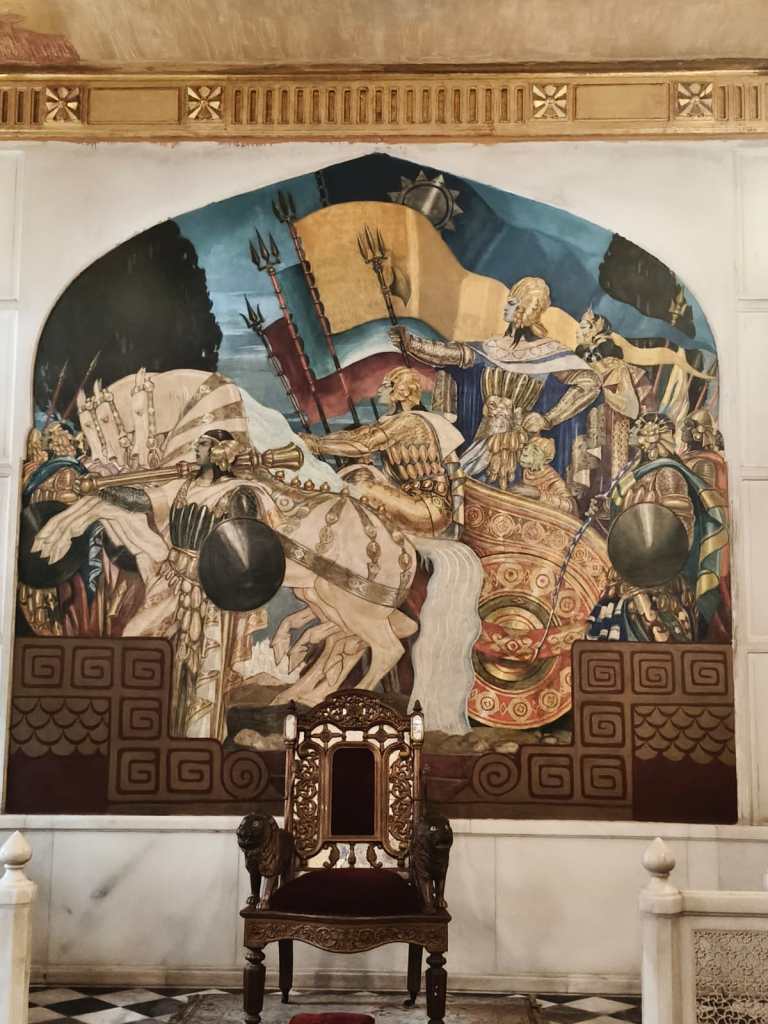
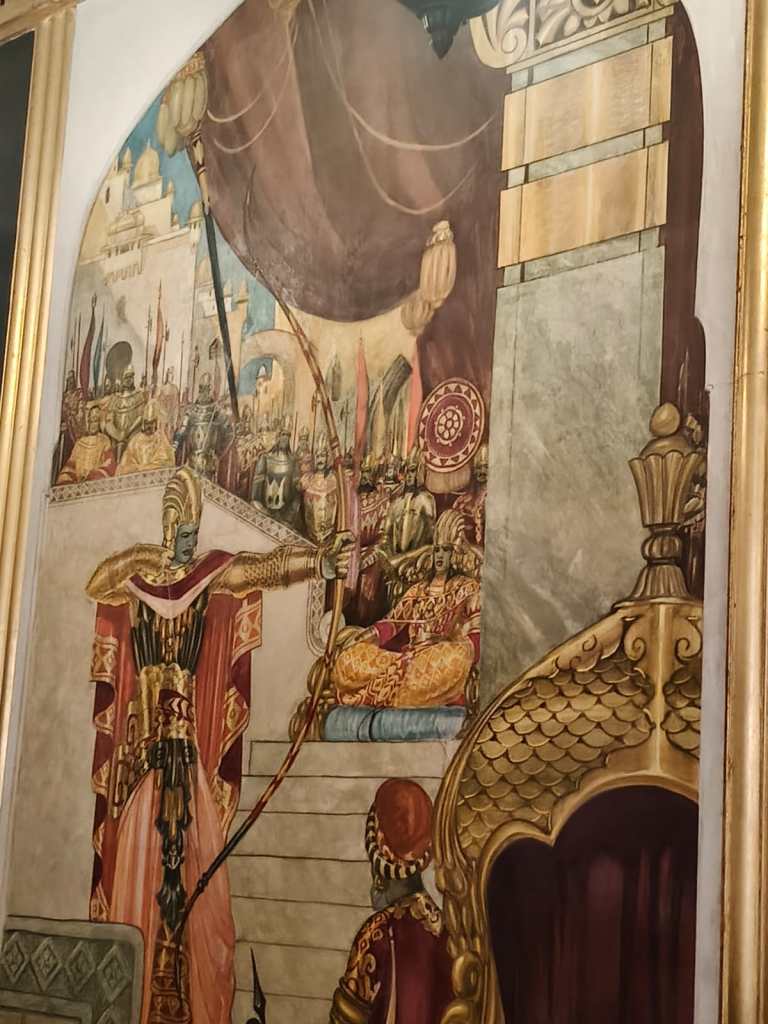
The palace, considered to be the last to be built before India’s independence, was a famine-relief project of Maharaja Umaid Singh. Umaid Singh was in every sense a Maharaja. He set up India’s earliest aerodrome in Jodhpur, hunted across continents, commissioned one of India’s most opulent palaces and tragically died of appendicitis at 44, while on a tiger hunt in Mount Abu. The Ramayana frescos in the Palace are worth viewing. They were painted by a Pole Stephan Norbik, who landed up in India during the Second World War. Its not often that one gets to see Rama and Sita depicted in an Art Deco style. Norbik later committed suicide at the age of 61 after a long battle with glaucoma.

Historically, the Rathores had their seat of power in Kannauj. After losing Kannauj to the Turks in the late 12th century, they migrated to Rajasthan, established themselves in Marwar, and eventually founded Jodhpur under Rao Jodha in 1459. Our driver who drove us around the Bishnoi villages, made it a point to explain this Kannauj ancestry. 😊
Now coming to the Bishnois. While the blackbucks that roam around the Bishnoi habitats are the main draw, one can never miss the looming invisible presence of the star of Hum Saath Saath Hain. Today, the spot where the ‘shooting’ happened, is also commemorated with a statue! We managed to spot a few Nilgais, chinkaras and the famed blackbuck.

And finally for some history trivia. During the partition of India, the princely states could join India or Pakistan only if they shared a border with either of the countries. So to ensure that Pakistan wouldn’t end up encroaching into the Indian mainland, it was critical to secure the bordering princely states. Sam Dalrymple in his superb ‘Shattered Lands’ writes:
Given that a state could only join a dominion it bordered, the solution for Menon and Patel was to ensure a wall of states from Punjab in the north down to Gujarat in the south acceded to India before Independence Day on 15 August. This would be ensured most effectively if they could bring round just four states: Bikaner, Jodhpur, Jaisalmer and Cutch.
Tourist guides in modern India are often oblivious that some of the country’s most celebrated tourist destinations – from the blue city of Jodhpur to the golden dunes of Jaisalmer – very nearly became part of Pakistan. Indeed Jinnah’s offer to the Maharajas of Jodhpur and Jaisalmer was tempting. ‘Your Highness,’ he said, ‘I sign on the dotted line, and you fill in the conditions.’ Signing the paper with a fountain pen, Jinnah handed it to the twenty-four-year-old Maharaja of Jodhpur, who nervously turned to the much younger ruler of Jaisalmer for advice. Jaisalmer responded that he would sign on one condition: ‘If there was any trouble between the Hindus and Muslims, he would not side with the Muslims against the Hindus.’ Jodhpur paused, and quickly his aide-de-camp, Colonel Thakur Kesari Singh, whispered into his ear the words, ‘Your Highness, before you sign, you must ask your mother.’ Singh’s appeal to matriarchal authority saved the day for the Indian government. The Maharaja postponed signing away his future and returned to the blue city of Jodhpur where his mother and his guru both pressed him not to join Pakistan. Three days later he returned to Delhi still anxious and conflicted, but when Mountbatten also pleaded for him to join India, he was convinced. That afternoon, on 11 August, Jodhpur signed India’s Instrument of Accession rather than Pakistan’s. The moment Lord Mountbatten went out of the room, however, Menon writes that:
“The Maharajah [of Jodhpur] whipped out a revolver, levelled it at me and said: ‘I refuse to accept your dictation.’ I told him that he was making a very serious mistake if he thought that by killing me, or threatening to kill me, he could get the accession abrogated. ‘Don’t indulge in juvenile theatricals,’ I admonished him.”
Menon’s ‘near-death experience’ would become the stuff of national myth in decades to come. Only later did it emerge that he had exaggerated the incident and that the ‘revolver’ was in fact a magic prop.
Jodhpur’s decision was a turning point and within a day both Cutch and Jaisalmer had also thrown their lot in with India. A wall of states along India’s western flank from Punjab to Gujarat had now cut off most of the princely states from Pakistan; with the stroke of a pen, the possibility of a vastly larger Pakistan had been averted.
The blue city vibes of certain streets are a marketing gimmick. I had to strain my eyes to see the blue of the Blue City.
Discover more from Manish Mohandas
Subscribe to get the latest posts sent to your email.
