When the Russians entered Berlin in 1945, the most feared words for a woman in Berlin were ‘‘Frau, komm’ (Woman, come)! For Antony Beevor, the occupation of Berlin by the Russians resulted in the ‘greatest phenomenon of mass rape in history’. Close to 100,000 women in the city were raped irrespective of their age.
Frederick Taylor, in ‘The Berlin Wall: A World Divided, 1961-1989‘ writes:
The post-war Soviet War Memorial in the Tiergarten was known, with typical dark Berlin wit, as the ‘Tomb of the Unknown Rapist’. The two million abortions a year carried out in occupied Germany in the immediate post-war period, mostly in the Soviet Zone, witnessed unimaginable suffering, as did the rocketing incidence of venereal disease and the 150,000 to 200,000 ‘Russian babies’ born as the result of the rapes. Such problems were described in Soviet military literature as applying to ‘women who have been visited several times by soldiers of the Red Army’.
While reading up on Berlin, a peculiar trivia that i came across was around the Berlin Airlift. When the Allied forces occupied the Western zone, Stalin decided to encircle the zone with a blockade. All rail, land and water access to West Berlin was cut off. The West being the west, took on the challenge head-on and the first conflict of the Cold War was born. During the 15 months of the blockage beginning in June 1948, an incredible 277,000 flights serviced Berlin transporting essential food and supplies. (The Math turns out to show one flight every three minutes across the fifteen months!). The Russians rattled every incoming aircraft with dangerous passes and by shining blinding lights into the incoming cockpits. Leon Uris’s ‘Armageddon: A Novel of Berlin’ has treated this story memorably in fiction. I probably read it 20 years back.
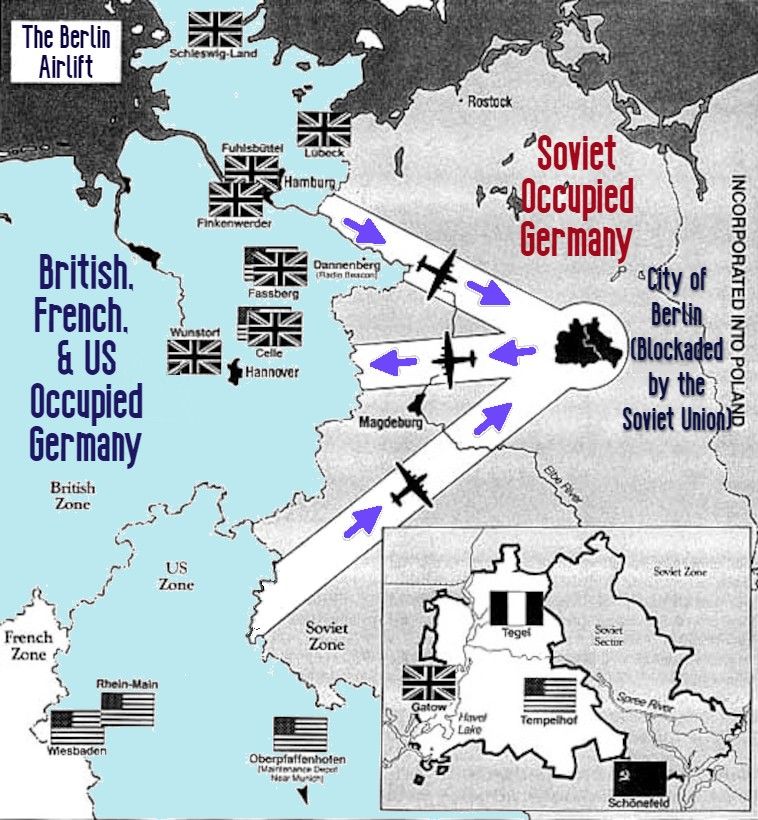
Again, Taylor on the architects of this mission:
Wedemeyer had commanded the China Theatre in 1944-5. He was familiar with one of the most famous supply operations in history: the Allied airlift from India across the Himalayas (the ‘Hump’) to Chinese troops fighting in southern China and Burma. Wedemeyer thought an airlift for Berlin could work, and suggested a suitable organiser—another veteran of the ‘Hump’, Lieutenant-General William H. Tunner.
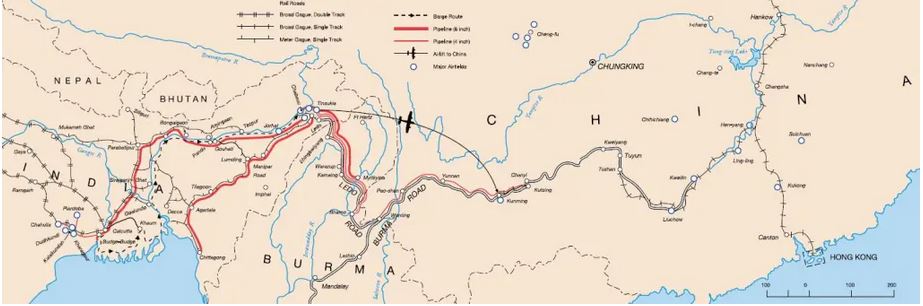
When the Japs occupied Burma, the Burma Road was cut off. For the next three years, it was American aircraft that supplied the Chinese and kept the war against the Japs going on. According to this source:
The Hump route, went from Assam, in the northeast corner of India (where the Air Transport Command crews lived under canvas, alternately broiled by the tropical sun or drenched by the monsoon), skirted Japanese-held north Burma, and then climbed “over the Hump” – 400 miles east to Kunming, in South China.
The ground temperature at take-off beside the Brahmaputra was regularly over 100 degrees in the shade, and the planes were parked in the sun during service and loading. An hour after take-off, over that tortured geography where the Himalayan snows spawn the Irrawaddy, the Salween, and the Mekong, as well as the great Yangtze Kiang that pours northeast out of Tibet and across China, coffee froze in the containers, and on sweat-drenched uniforms the caked ice crackled.
Arunachal Pradesh has a new museum dedicated to the Hump at Pasighat!
Discover more from Manish Mohandas
Subscribe to get the latest posts sent to your email.

Very interesting to learn about the connection between Hump Airlift Operations and the Berlin Airlift.
The Hump Airlift Operation was about containing the spread of Communism to Asia. The Soviets were helping the Communist Red Army against the Nationalist Army. President Harry Truman eventually suspended these Airlift effort as he got totally frustrated by the Nationalist leaders who were dishonest and corrupt and failed to battle against the Communists with real zeal and conviction. Eventually, the Nationalists retreated to Formosa or Taiwan and the Communists won the mainland of China declaring victory on October 01, 1949.
LikeLike