If you were an East German during the Cold War, the Stasi (East German Secret Police) scrutinized every aspect of your life. Letters would be read, houses and offices would be bugged, suspects could be trailed, and any suspicion of wrongdoing could lead you to the interrogation chambers. The Stasi even saved up scents of suspects and dissidents to be used by search dogs. Every typewriter in East Germany had a unique identification number so that anonymous letters could be traced back to its source.
After the Wall fell the German media called East Germany ‘the most perfected surveillance state of all time’. At the end, the Stasi had 97,000 employees—more than enough to oversee a country of seventeen million people. But it also had over 173,000 informers among the population. In Hitler’s Third Reich it is estimated that there was one Gestapo agent for every 2000 citizens, and in Stalin’s USSR there was one KGB agent for every 5830 people. In the GDR, there was one Stasi officer or informant for every sixty-three people.
When the Wall fell in ’89, the headquarters of the Stasi at the Normannenstrasse were raided by the public. What met the protestors were fifteen thousand sacks of shredded and hand-ripped files, index cards, photos and unwound tapes and film. Today, archivists are painstakingly piecing together all of this material in what is considered to be the world’s largest and most complex jigsaw puzzle.
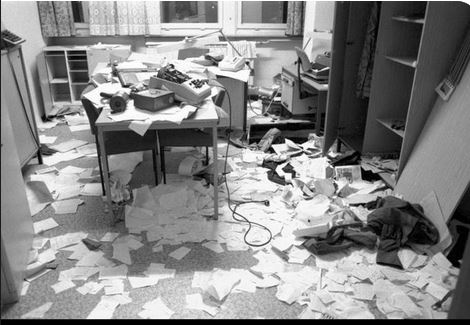
Anna Funder, in her supremely readable Stasiland writes:
The Stasi File Authority—Project Group Reconstruction Time required for the Reconstruction: 1 worker reconstructs on average 10 pages per day 40 workers reconstruct on average 400 pages per day 40 workers reconstruct on average in a year of 250 working days 100,000 pages There are, on average 2,500 pages in one sack 100,000 pages amounts to 40 sacks per year In all, at the Stasi File Authority there are 15,000 sacks This means that to reconstruct everything it would take 40 workers 375 years.
New technology has now sped up the process as reported here by the BBC and the New Yorker. I’m sure that AI might soon speed up the exercise. The moving aspect of this project is that it’s a form of protest – against authoritarianism – and a reminder of the importance of safeguarding individual liberties. Each piece of paper patched up and shared with a victim provides some form of closure and becomes an acknowledgment of the lives that might have been better lived but were not.
(For a visceral portrayal of this aspect of East Germany, check out the 2006 German movie – The Lives of Others. Must re-watch it soon).
Discover more from Manish Mohandas
Subscribe to get the latest posts sent to your email.

One thought on “The World’s Largest Jigsaw Puzzle”