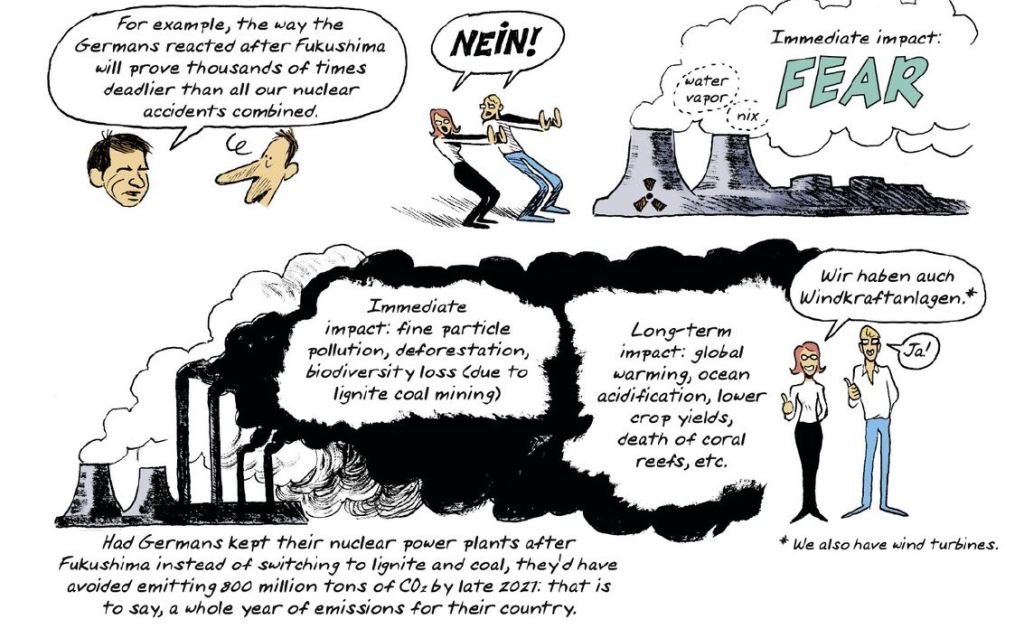
Jean-Marc Jancovici and Christophe Blain’s ‘World Without End‘ – a comic about Climate Change that outsold Asterix in France in the year of its launch was a sharp, engaging introduction to Energy Sources and Climate Change.
The panels that caught my attention were the ones explaining the long-term impacts of Chernobyl and Fukushima. According to the United Nations Scientific Committee on the Effects of Atomic Radiation (UNSCEAR), the main health effects of Chernobyl were:
- 134 plant staff and emergency workers suffered acute radiation syndrome (ARS) from high doses of radiation
- In the first few months after the accident 28 of them died
- Although another 19 ARS survivors had died by 2006, those deaths had different causes not usually associated with radiation exposure
- Skin injuries and radiation-related cataracts were among the most common consequences in ARS survivors
- Thyroid cancer was the most prevalent ‘outbreak’ with more than 6000 cases documented. However its impact on mortality has been negligible.
On Fukushima, the UNSCEAR concluded that “no adverse health effects among Fukushima residents have been documented that could be directly attributed to radiation exposure from the accident”. During COP 26 in Glasgow, Rafael Grossi, the head of the International Atomic Energy Agency famously schooled the guffawing audience when he stated: “None died from radiation [at Fukushima]”. I remember seeing this video then but couldn’t trace it now.
In short, contrary to popular imagination, Chernobyl and Fukushima weren’t deadly nuclear accidents.
The real cost of Chernobyl and Fukushima has been the spread of fear surrounding nuclear power. By every metric, nuclear power is safe compared to coal, which kills millions through both extraction and the long-term effects of air pollution. The German response to Fukushima was arguably the most far-reaching—Merkel, a Ph.D. in Physics, decided to shut down all the country’s nuclear plants. This decision, reportedly, was made ‘after discussing it one night over red wine with her husband, Joachim Sauer, a physicist and university professor, at their apartment in central Berlin.’
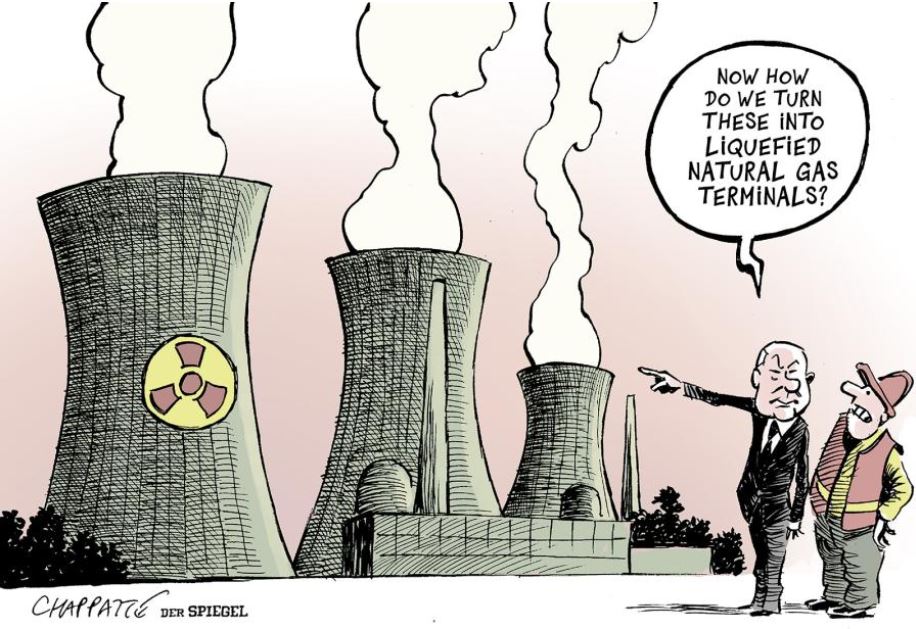
The pariah status of nuclear energy has hindered significant private-sector investment and innovation in the field. As a thought experiment, imagine the progress in terms of additional safety and generation costs that could have been achieved if nuclear power was embraced as a clear favorite. Nevertheless, in recent years, small and sustained efforts in this direction have started showing promising signs of progress. Small modular reactors, envisioned to be someday regulated as simply as X-ray machines, may represent the future of nuclear power. Developments like Google purchasing nuclear energy, Bill Gates’ investment in TerraPower, India’s push for SMRs, Kerala’s pitch to capitalize on its huge thorium deposits, and advances in nuclear fusion technology are the potential pathways that we need to explore to combat climate change effectively.
Any serious effort to address climate change must include nuclear power alongside solar, wind, and other renewable energy sources. For this to happen, we must collectively reassess our understanding of, and biases against the safest and cleanest source of power.
In Psychology, the Availability Heuristic is a cognitive distortion by which we make decisions or judgments based on how easily examples or instances come to mind. If something is more memorable, vivid, or frequently reported, we tend to perceive it as more likely or representative, even if it’s not. So each time nuclear power is mentioned, often, its the image of a mushroom cloud that comes to our mind rather than the image of a modern, high-GDP country whose 70% of energy needs are met by nuclear power – France.
Nuclear proliferation is a serious threat and eternal vigilance is key. Anne Jacobson’s Nuclear War: A Scenario, is a great work if you really want to get frightened of the prospect of Nuclear Armageddon. (My review.)
On Nuclear waste, do check out this earlier post.

For a deep dive into the statistics of nuclear power, its worldwide share, safety record and other data points alluded above, check out Our World In Data’s page on Nuclear Energy.
Discover more from Manish Mohandas
Subscribe to get the latest posts sent to your email.

Quite an interesting read. Amidst the discussion on sustainable energy sources to power Industry 4.0 – as MAANG companies look to power data centers using nuclear fusion, this is a nice start to a debate on overcoming the fear of embracing nuclear energy.
The anecdote on Angela Merkel and her decision to dismantle nuclear energy in Germany, shows arbitrary decision making continues to be a part of policy decision making across continents.
And your blog is a tremendous knowledge source to tap into to learn about climate change and energy efficiency.
LikeLike