Zena Hitz in ‘Lost in Thought: The Hidden Pleasures of an Intellectual Life’ offers a fascinating exploration of whether Mary was an intellectual.
An ancient Syriac dialogue between Joseph and Mary imagines Joseph rebuking Mary for her apparent unchastity while Mary rebukes him in turn for his inferior knowledge of the scriptures:
JOSEPH: You have gone astray like water, chaste girl; just take the Scriptures and read how virgins do not conceive without intercourse, as you are saying.
MARY: You have gone astray, Joseph; take and read for yourself in Isaiah it is written all about me, how a virgin shall bear fruit; if that is not true, do not accept my word.
Mary’s love of study is held up by the church fathers as a model for Christian believers. Ambrose includes “studious in reading” in a catalog of her virtues, and he explains the condition in which the angel found her: [Mary], when the angel entered, was found at home in privacy, without a companion, that no one might interrupt her attention or disturb her; and she did not desire any women as companions, who had the companionship of good thoughts. Moreover she seemed to herself to be less alone when she was alone. For how could she be alone, who had with her so many books, so many archangels, so many prophets? Her bookish solitude is a sign of her independence, her lack of ambition, her focused absorption in the task at hand. It is emphasized at the moment of the angel’s appearance, because the angel’s proposal is a challenge comparable only to God’s invitation to Abraham to slaughter his son.
Mary’s response to Gabriel’s announcement of the Immaculate Conception was: “How can this be?”
Her studiousness is also part of the meaning of Mary’s perpetual virginity. She does not submit to the common purpose that her community established for women—sexual pleasure and the extension of clans and bloodlines. So her virginity also secures her dignity, her standing beyond mere social utility. The social world is a realm of suspicion: the locus of ambition and competitive striving, the engine of using and instrumentalizing, the dissipation of energy into anxiety and petty spites. Only in withdrawing from it can the fundamentals of human and divine life become clear.
This withdrawal from regular life, and the choice to immerse oneself in reading are the hallmarks of an intellectual life. In paintings, Mary is often shown with a book. Google throws up so many startling ones. While the intellectualization of Mary might be interpreted as an attempt to project a halo around her, I had never before encountered this intriguing dimension of her personality.
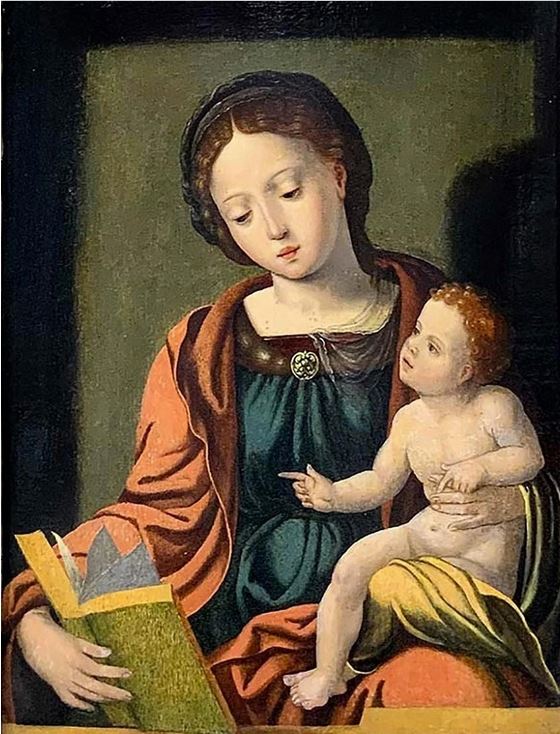
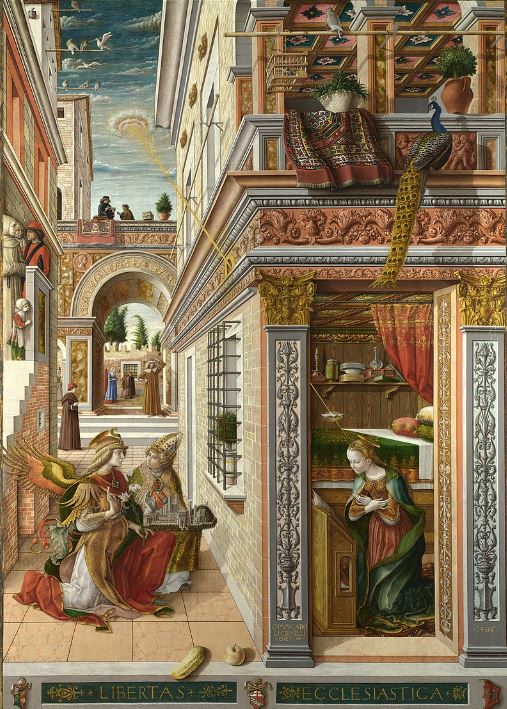
Cover Image: Madonna of the Book by Boticelli
Discover more from Manish Mohandas
Subscribe to get the latest posts sent to your email.
