In ‘The Golden Road: How Ancient India Transformed the World‘, Dalrymple’s thesis is that once upon a time, India was the center of the world. It was the land that exported its goods, gods, ideas and science to the rest of the world that in turn shaped the world as we know it today. Most aspects of this story were known to me.
Thanks to Ashoka’s conversion after the Kalinga War, Buddhism was resurrected, and from a small sect became a massive domestic and global export. As Buddha was not averse to receiving monetary support from the rich, the perfect symbiosis between India’s monks, traders and international merchants made India the axis of global trade.
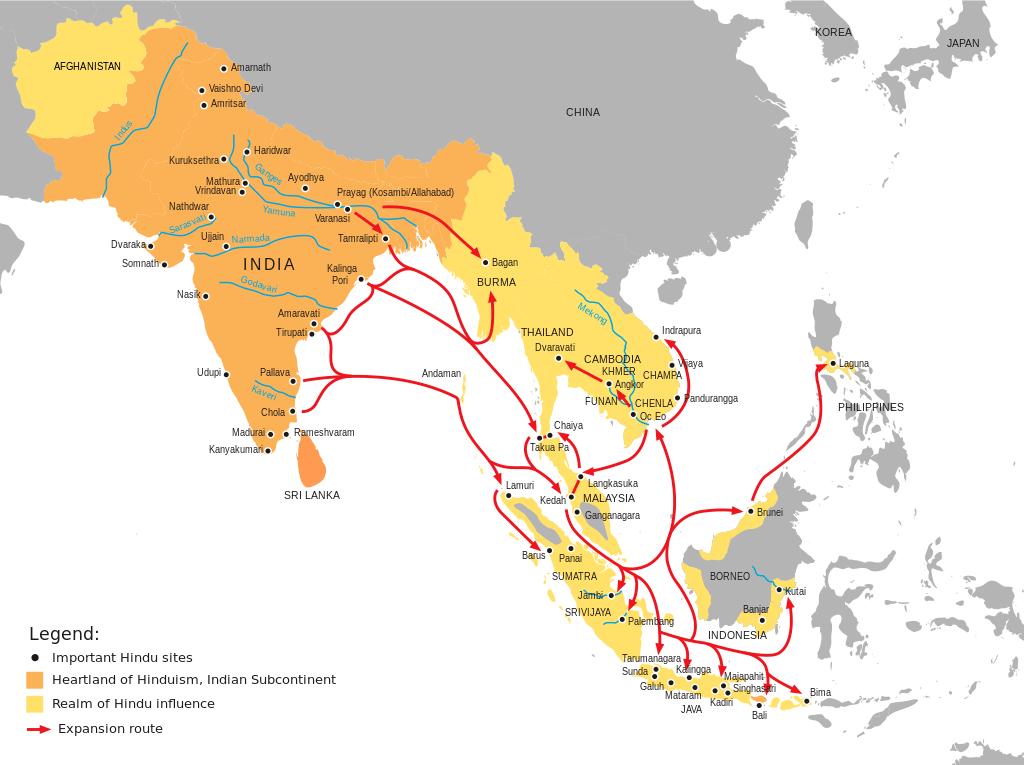
No wonder foreigners, and especially foreign Buddhists, were welcomed with open arms at these monasteries and appear so frequently in their murals: the wealth they generated and showered on these communities was one of the driving forces that financed the growth and prosperity of the Indian Buddhist monastic movement. In turn, the monks would help take the religious ideas of the Buddha, first dreamed up far inland between the Himalayas and the Ganges, out into a much wider world, west via the Red Sea to Alexandria; south to Sri Lanka; and east, from Bengal, Orissa or the Andhra coast to Suvarnabhumi, the Lands of Gold: Burma, Thailand, Java, Sumatra, Cambodia and Vietnam.
After the death of Ashoka, Buddhism found the going hard. The Gupta popularized the worship of Hindu deities carved in stones and housed in massive temples. Hindu gods were no longer abstract entities to be invoked through sacrificial hymns. The Puranas of this period crystallized the forms of Vishnu, Shiva and Krishna. (Earlier related post).
When Rome collapsed, India then set its sights on S.E Asia. Borobudur in Indonesia and Angkor Wat in Cambodia are two of the greatest monuments of the legacy of India’s influence. The southern empires of the Pallavas (who built Mahabalipuram) and the mighty Cholas also contributed to the making the Bay of Bengal an Indosphere.
The birth of the Prophet and the spectacular spread of Islam, brought Indian science and astronomy to the courts of the Caliph in Baghdad. For Dalrymple, it was India that gave the West its foundation for its future scientific superiority. It was the rise of Islam and the domination of the Mongols which eventually bolstered the overland route from China to Europe, that eventually took on the moniker of the ‘Silk Roads’. Dalrymple argues that the popular imagination of these roads, which Marco Polo, famously trudged over, as the original ancient connection between the East and West needs to be revisited. The glut of Roman coins that still turn up in archaeological digs across India is proof of this. (Roman coins in China, on the other hand, have a very limited footprint).

By the turn of the first millenium, Gujarati traders and Sufi mystics began exporting Islam to South East Asia. Today, Indonesia is the largest Islamic country in the world, and a fascinating land with a storied past – thanks to stellar contributions from India.
P.S: If you’re curious, an online illustrated lecture by Dalrymple on the topic can be accessed here and is a good summary of the book:
Discover more from Manish Mohandas
Subscribe to get the latest posts sent to your email.

2 thoughts on “The Golden Road”