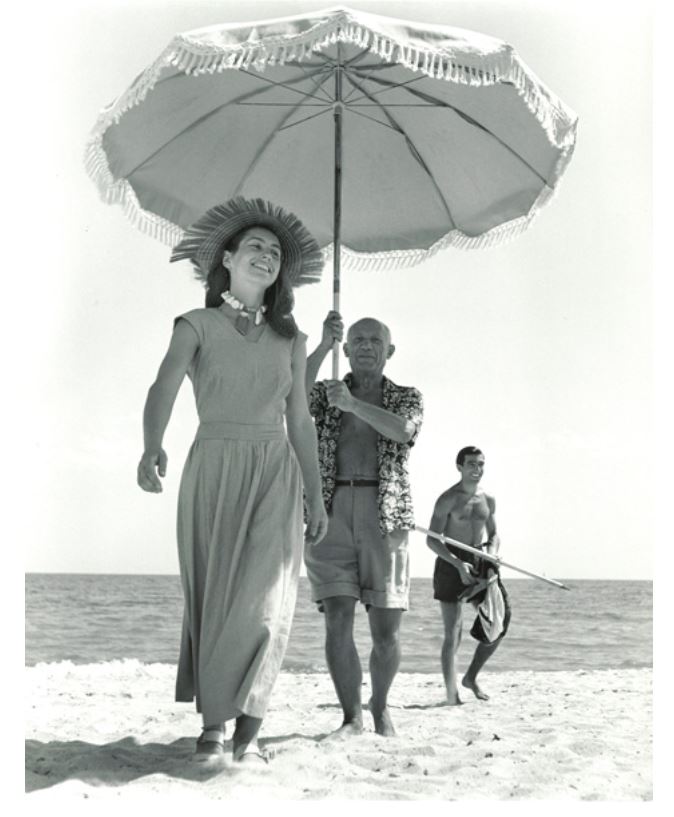
There’s a famous photograph of Robert Capa’s that has been pinned to the bulletin board above my desk for a number of years. It was taken in 1948 on a beach in France, and it shows a smiling young woman dressed in a cotton gown and a large straw hat striding forward across the sands while a sturdy-looking old man walks behind her, holding a huge umbrella over her head: a queen and her slave. The young woman is Françoise Gilot and the old man Pablo Picasso. As Robert Capa was an artist, the picture is charged with emotional complexity. At first all the viewer registers is the lit-from-within triumph in Gilot’s smile; and right behind it Picasso’s amiable servitude. But keep looking and you’ll see in Gilot’s eyes that she believes her power everlasting; and then you’ll see the cold worldliness behind Picasso’s playacting deference. It hits you full force: Gilot is Anne Boleyn in her moment of glory and Picasso the appetite-driven king before he’s had his fill of her. The photograph is so richly alive, it is actually shocking: it both excites and appalls. Most days I don’t even glance in its direction, but on the days that I do take it in, it never fails to arouse pain and pleasure, in equal parts. It’s the equal parts that’s the problem.
Came across this excerpt from the feminist Vivian Gornick’s memoir – The Odd Woman and the City. Gornick examines her relationships in the backdrop of her lived experience of being a New Yorker. The public places, the streets, the art spaces, the commute, the people, the violence and the draw of the city shine through the pages. Some excerpts:
There are two categories of friendship: those in which people enliven one another and those in which people must be enlivened to be with one another. In the first category one clears the decks to be together; in the second one looks for an empty space in the schedule.
As the years went on, I saw that romantic love was injected like dye into the nervous system of my emotions, laced through the entire fabric of longing, fantasy, and sentiment. It haunted the psyche, was an ache in the bones; so deeply embedded in the makeup of the spirit, it hurt the eyes to look directly into its influence. It would be a cause of pain and conflict for the rest of my life. I prize my hardened heart—I have prized it all these years—but the loss of romantic love can still tear at it.
She also argues that it was Dickens and Hugo who for the first time portrayed the ‘crowd’ as key protagonists in their works and also wrote keeping the possibilities of the same ‘crowd’ bringing them commercial success:
The two greatest writers of the urban crowd in the nineteenth century were Charles Dickens and Victor Hugo. Each, in his own way, had grasped whole the meaning of these metropolitan masses rapidly developing in London and in Paris. Dickens especially understood its significance. To see a swiftly moving man or woman out of the side of your eye—to feel his or her presence at an angle of vision that allowed one to register only half a face, part of an expression, a piece of a gesture; and then to have to decide quickly how to react to this flood of human partialness—this was creating a radical change in social history. Victor Hugo, along with many other nineteenth-century writers, saw the same thing and understood, as Walter Benjamin put it, that there was no subject more entitled to his attention than the crowd. It was Hugo’s shrewdness, Benjamin wrote, that made him see the crowd “was getting ready to take shape as a public … who had acquired facility in reading” and was becoming the kind of purchaser of books that “wished to find itself portrayed in the contemporary novel, as the patrons did in the paintings of the Middle Ages.”
Will pick up her celebrated Fierce Attachments next.
Discover more from Manish Mohandas
Subscribe to get the latest posts sent to your email.

One thought on “Vivian Gornick on Picasso…”