How did the idea of the ‘West’ emerge? Naoíse Mac Sweeney, in a sweeping narrative, presents a compelling argument in The West: A New History in Fourteen Lives. The Greek and Roman empires are central to the identity of the ‘West’ today. But how did this narrative arc emerge? Her fascinating arguments:
Herodotus, in his Histories documented for the first time the Persian Wars that were fought between the Greeks and the Persians. For the first time, the world is presented with the concept of ‘Us’ vs ‘Them’. The ‘Them’ here being the barbarian Persians. (In popular culture, the movie 300, based on the Battle of Thermopylae showed the Persians as vile, creepy dark-skinned monsters ).
The Greeks were followed by the Roman Empire. The founding myth of Rome has a direct connection with the ‘East’. After the sacking of Troy by the Greeks, the Trojan prince Aeneas landed up in Italy and it was his descendants – Romulus and Remus that gave Rome its name. But Rome being Rome hardly bothered about ideas of racial purity and superiority. A Roman could be anyone living within the empire – be it Italy, Sardinia, Alexandria or Damascus.
The Dark Ages: While the idea of the West is rooted in the Roman-Greek legacy, the path connecting the two was never direct. The detour had to be taken via Islamic Arabia. During the Dark Ages, despite monasteries becoming centers of study, the real cosmopolitan centers of learning were in Baghdad and the rest of the Islamic world. The Arabs translated the key Greek texts and ensured their eventual transmission to Western Europe. The Greek empire of antiquity was also not limited to ‘Europe’.. Modern-day Afghanistan, Pakistan, and India had strong Greek imprints, thanks to Alexander and Seleucus Nicator’s kingdoms. (The Gandhara School of Art, with their realistic creations, and draped garments are the finest examples of Greek influence. The seated Buddha in the Sarnath Museum is probably the epitome of the Greek imprint in our culture).
The Catholic-Orthodox Schism: The fallout between the Roman Catholic Church and the Eastern Orthodox Church based out of Constantinople was probably the earliest demarcation of Europe as a politico-religio-legal entity that was different from the Byzantine empire.
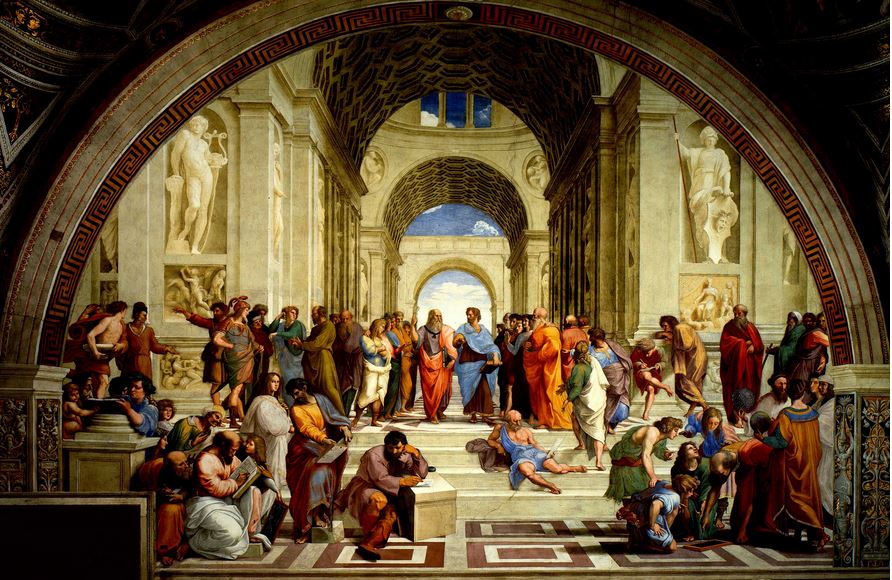
The Renaissance that took birth in Italy, was marked by a rediscovery of the Greek ‘heritage’. All of a sudden, everything Greek became fashionable and a marker of high status. Petrarch’s translations, Raphael’s ‘School of Athens’ (one of my favorites), and the Médicis establishing a School of Plato brought back Greece into the mainstream. Everything Greek became central to the idea of a good life.
The fall of Constantinople to the Ottomans and the capture of Grenada by Spain, demarcated Christian Europe from the Islamic East. The Protestant Reformation and the ensuing blood bath in Europe did result in some tantalizing alliances explored between Elizabethan England and the Islamic Ottomans to rein in the Catholic Hapsburgs. Though nothing came of these explorations, it is worth wondering how different our world would have been had the Catholics been wiped out from Europe by an Islamic-Protestant alliance.
Two global events of the 17th century baptized the idea of the West. The American Independence Movement and the Industrial Revolution that led to colonialism backed by mercantile capitalism. For the Founding Fathers, it was America that would henceforth be the torchbearers of the ideas of the ‘Old’ West. The Roman imperial courts were their inspiration and once again we had the Greco-Roman influences being central to the ideas of superiority. Colonialism and encounters with the natives of Africa and Asia brought racial superiority as a unifying identify of the White ‘superior’ race and a shared understanding of how unique and similar they were vis-à-vis the natives they encountered in foreign lands. Kipling’s ‘The White Man’s Burden’ poem sums up this view neatly for posterity.
In the 20th century, the West has seen radical changes. The post-World War II era and the end of the Cold War with Russia’s defeat led to the idea of Western liberalism, free markets, and social welfarism being the dominant feature of the ‘West’. Fukushima even argued that the End of History was here with Liberalism being the grand unifying theme of the whole world after the fall of the Berlin Wall. But that narrative too has shifted. Al Qaeda and later ISIS’ challenge to American hegemony, Putin’s own version of his motherland’s history and his shenanigans in Ukraine, China’s marketing of the Belt and Road Initiative as a counterpoint to the West’s overtures, and India’s harping of its civilizational ethos (including a Mother of Democracy branding which pre-dates the Athenian democracy) are all ongoing challenges to the idea of the ‘West’. The potential return of Trump (despite the Capitol Building attack), the rise of Le Pen in France, Meloni in Italy, and an overall resurgence of the Right are interesting developments in the ongoing discourse over the idea of ‘West’ and what it stands for!
Aeneas entered Italy after fleeing war-torn Troy and his heirs gave birth to the Roman Empire. The same Italy today (read Europe) is grappling with migration as one of its most critical issues with some going to the extent of clarifying that Aeneas was never a refugee. While Rome is seen as the cultural heir of the Greeks, hardly anyone in the West is bothered by their origins. Troy is in modern-day Turkey.
Discover more from Manish Mohandas
Subscribe to get the latest posts sent to your email.
