Kyoto was the first choice as the target for the atomic bomb during World War II. It was an industrial center, had production capabilities of close to four hundred aircraft engines a month, and was an intellectual center of Japan. Hitting it was calculated to deal a body blow to Japanese morale. However, at the last moment, Kyoto was dumped as the target, and the second option – Hiroshima was chosen. The rest, as they say, is history. The reason for this is itself a fascinating slice of history that reaffirms how chance events shape our lives. The Secretary of War Henry Stimson had honeymooned in Kyoto nineteen years earlier and was mesmerized by the cultural depth of the city. There was no way that memory was going to be obliterated under his watch. (The third city on the list was Kokura but due to dense cloud cover, the pilots of B-29 bomber had to adapt and drop the weapon on Nagasaki. Kokura’s Luck is a common phrase in Japan to this date.)
Despite the war ending in Europe on 8th May 1945 (VE Day), the fighting in the Pacific raged on till August. One of the reasons for America deciding to exercise the nuclear option was the sheer tenacity with which the Japanese fought. The Marines literally hopped from island to island, fought brutal campaigns and inched their way across the Pacific towards the Japanese mainland. Guam, Guadalcanal, Peleliu, Pavuvu, Okinawa are all seminal battlefields of the campaign.
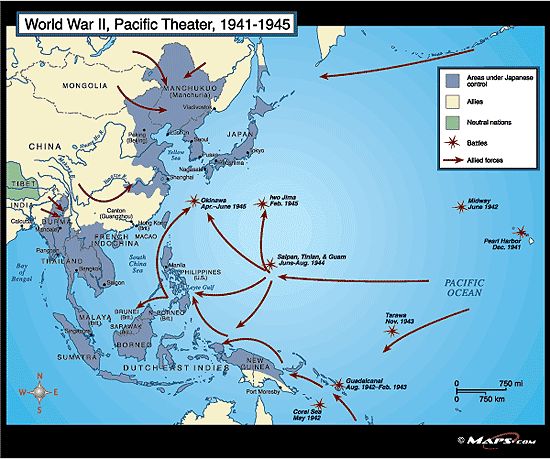
For an immersive experience of the Pacific theatre, do check out 2010 TV series ‘The Pacific’. Produced by Steven Spielberg and Tom Hanks, the ten-part series is television at its finest. Remembrance of the past has to be facilitated by literature and the arts and one has to give it to Hollywood to keep alive America’s role in the War and often over-emphasize it. (Few know that Soviet Russia lost around 27 million lives in the War against American causalities of 400,000. India itself lost 90,000 soldiers in WWII and the civilian toll was also in the millions specially if you include the Bengal Famine. That’s the power of the visual medium!) The series paints the horrors of the campaigns, the muck and rains, the eerie silences, and even the Americans hunting for Samurai swords and plucking out the golden teeth of the dead Japanese as souvenirs. Soon after finishing it, I also checked out the 1998 multi-starrer ‘The Thin Red Line’ and Clint Eastwood’s 2006 movie: ‘Letters from Iwo Jima’, a moving and devastating portrait of the Battle of Okinawa from the Japanese perspective.
Okinawa alone cost the Americans eight thousand lives. Estimates for the casualties in the eventuality of a mainland invasion of Japan were pegged at close to 95,000. With the war in Europe complete, this was simply too high a price to pay. America went nuclear and the atomic age was here forever.
I couldn’t help but wonder why are there hardly any Indian versions of our contributions to the Great War and the Second World War? Despite a million Indians fighting in the First and two million plus in the Second, I can only think of books by Yasmin Khan, Srinath Raghavan and Raghu Karnad but can’t recollect any memorable on-screen commemoration of this. We should learn from Hollywood which decided to put in $100 million for a ten-part series. The Pacific is the second in the trilogy, each dealing with America’s army, naval, and air campaigns in WWII. The first was Band of Brothers released in 2001 and the third is ‘Masters of the Air’ currently being streamed in Apple TV. Will write about these two soon.
PS: An earlier piece referring to the Japanese conquests can be read here.
Discover more from Manish Mohandas
Subscribe to get the latest posts sent to your email.

5 thoughts on “The Pacific Theatre in WWII”