During this era Singapore Airlines, a government company, ran a centerfold advertisement that featured an Asian woman of somewhat vague ethnicity. She could have been Chinese, Indian, or Malay. She stood in a misty, impressionistic setting, looking out at the reader demurely, holding a single water lily. There was no information about the airline’s fare rates or safety record, just this message in delicate print: “Singapore Girl . . . You’re a great way to fly.” On long-distance flights in the 1980s, when the majority of passengers were presumed to be male, Sri Lanka’s airline, also government-owned, declared, “When your business is business . . . our business is pleasure.”
Rejecting the model of the African American male porter made popular by American railroad companies, Boeing Air Transport’s manager initially thought that his flying customers would be most comfortable if they were serviced in the cabin by Filipino male stewards, adopting the racialized gendered imperial labor model chosen by the U.S. Navy, which routinely recruited Filipino men to work as personal stewards for its white navy officers. He changed his mind—and his gendered labor model—only when he was approached by Ellen Church, herself a nurse and a trained pilot. Church realized that the men who ran the fledgling airlines were unlikely to overcome their own sexist presumptions and hire a woman as a pilot, so she proposed that women trained as nurses—white women—would be most capable of serving as airline cabin crew members. They were skilled professionals and their presence in the cabin would reassure passengers, many of whom were only then overcoming their flying nervousness. The first eight women “stewardesses” took off with Boeing Air Transport in 1930. The feminization of the airlines’ cabin crews was rapid. By 1937, America’s airlines had in their employ 105 male stewards and 286 stewardesses. After World War II, with the rapid rise of international mass tourism, the masculinized cockpit crews were complemented by thoroughly feminized cabin crews.

This excerpt is a sample of the insights packed in Cynthial Enloe’s ‘Bananas, Beaches and Bases: Making Feminist Sense of International Politics’ – a refreshing analysis of feminist issues in global politics. Enloe dissects the gender dynamics existing in myriad international structures such as military bases, banana plantations, diplomacy, sweatshops, commercial air travel, tourism and nationalism. The power of a feminist analysis of any issue is that once you see it, unseeing it becomes next to impossible.
These troops were not as likely to seek sexual liaisons with working-class white women as with colonized women of color—Chinese women in Hong Kong, Indian women in India, Egyptian women in Egypt. British officials had been thwarted in their efforts to control white working-class women’s relationships with British military men in Britain. In the 1860s, in the wake of the disastrous Crimean War and at the behest of Britain’s generals and admirals, the men in Parliament, in the name of protecting male soldiers and sailors, had passed the Contagious Diseases Acts. These militarized laws, a form of national security policy, mobilized Britain’s civilian local policemen to arrest working-class women in army base towns and naval port towns whom those policemen suspected of being prostitutes. In practice, that was any working-class woman out at night on her own. The suspected women were compelled to undergo vaginal exams with the crudest of instruments. It was the Anti–Contagious Diseases Acts Campaign, led by British feminists of the Ladies National League, that (despite women being denied voting rights) effectively lobbied for twenty years to persuade the all-male Parliament of the unfairness of the Contagious Diseases Acts and to repeal them.
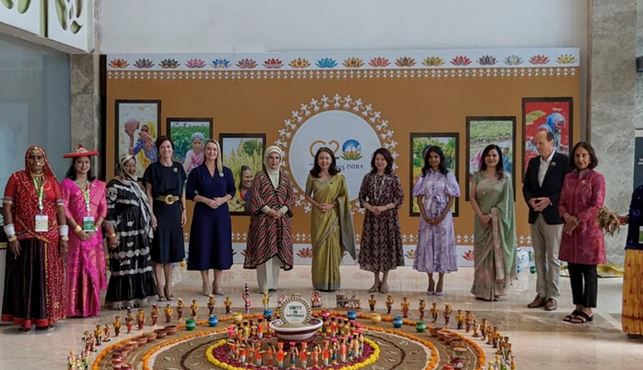
In the recently concluded G20 Leaders summit, the First Spouses (didn’t know that was even a word) had a separate programme crafted from them. While I did find the whole component slightly weird, I’m now a bit more sympathetic. Enloe has a whole chapter on the gendered role that spouses of diplomats, soldiers and the elites play in our society. Their charity events, social causes and other philanthropic excursions are the perfect accompaniment to the more ‘masculine’ work of their spouses.
The book could have been better informed with an economic analysis of how choice and labor economics drive a lot of decisions specially in societies that are predominantly agricultural. Sweatshops get a bad rap but its also pertinent to note that most of the Asian countries transitioned from subsistence to the services sector through the manufacturing/sweatshop route (The Lewis Model). While global supply chains – be it for bananas or textiles – can be ‘bad’ for women, the fact is that most of the women toiling are doing so out of their free will and for lack of alternate employment opportunities. And as with most feminist analysis, Enloe doesnt explore the hardships faced by men in the labour market. While she paints manufacturing and military investments as ‘masculine’ sectors, its also worthwhile to remember the horrific working conditions most men are subjected to. (All the 41 miners who were trapped in the Uttarakhand tunnel were men).
Despite some such lapses, the book should be widely read. You’ll at least end up with a lot of info on the skewed gender balance of international institutions and norms.
Discover more from Manish Mohandas
Subscribe to get the latest posts sent to your email.
