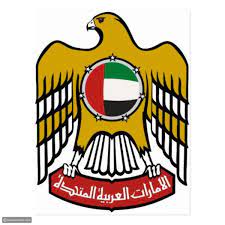
I grew up in the United Arab Emirates where the falcon is the national bird. It’s on the national emblem and hence an ubiquitous sight on stamps, official documents, government buildings etc. If you spend considerable time in the Middle East, it’s not uncommon to come across an Arab with a menacing falcon perched on his arms. Qatar also permits falcons to be carried in their airlines. Why and how did the falcon manage to become such a deep cultural symbol for the Arabs?
Until the 60s, the Middle East was an impoverished land. Pearl diving and piracy were the main sources of income for the tribes that dotted the coastline. All this changed with the discovery of oil beginning in the 40s and the subsequent unearthing of huge reserves across the countries. This burgeoning wealth led to mass migrations from all corners of the world. The Asians landed up to take care of the service sector and the menial jobs – construction, sanitation, transport and the Whites managed to ‘run’ the show. Racism in the Gulf is for real and quite in-your-face! (I had briefly written about the oil boom’s impact on the Greek shipping industry)
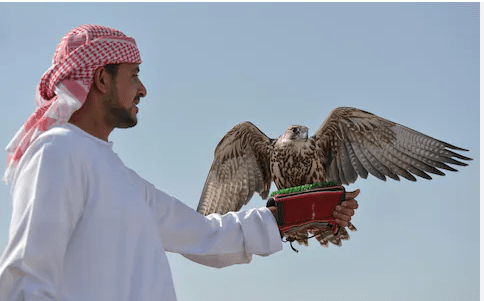
For the Arabs, the oil boom meant moving from camels to Lamborghinis within a generation. And when you find yourself as a minority (though an elite one), you search for markers of identity to make you stand out. And the falcon provides just that. For the Bedouins, the falcons’ prey used to be an additional source of scarce protein. The Quran specifically permits the meat of animals and birds caught by falcons to be consumed. Some of the conditions to be met for this are – the falcon needs to be trained, released by a master to ‘attack’ and the meat should not be consumed by the falcon. Seen in this light, falconry becomes a pursuit for the world’s wealthiest citizens to find ‘meaning’ and a link to take them to their distant pre-oil nomadic days of wandering. It’s meditative, pursued in harsh landscapes and often solitary.
Until the 70s, falcons used to be exclusively tamed from the wild. But with their populations dwindling, artificial insemination has become the key to sustaining their numbers. While the most common prey used in falconry are pigeons, the ultimate wet-dream of every serious falcon enthusiast is to see a falcon swoop down and capture a bird called the houbara – a kind of bustard.
Arabs today embark on hunting expeditions to Azerbaijan, Pakistan, Iraq and Iran in pursuit of the houbara. In 2014, a Saudi royal hunting party killed more than 2,000 Houbara bustards in a 21-day safari in Balochistan. But the most infamous falconry expedition is undoubtedly the 2018 hunting trip by the Qatari royals to Iraq.
In 2018, a group of Qatari royals, embarked on a falconry expedition to the remote Al Muthanna province of Iraq. They were captured by the ISIS, held in captivity for 16 months in a windowless basement and finally released after a ransom of close to $1 billion was paid by the Emir to the Shiites. The whole kidnapping was orchestrated to facilitate a 4-city-swap between Sunnis and Shiites in Syria (or in crude terms ethnic cleansing) to ensure that Iran’s interests would be maintained. I’d strongly recommend this deep-dive by the NYT which is as good as any spy thriller.
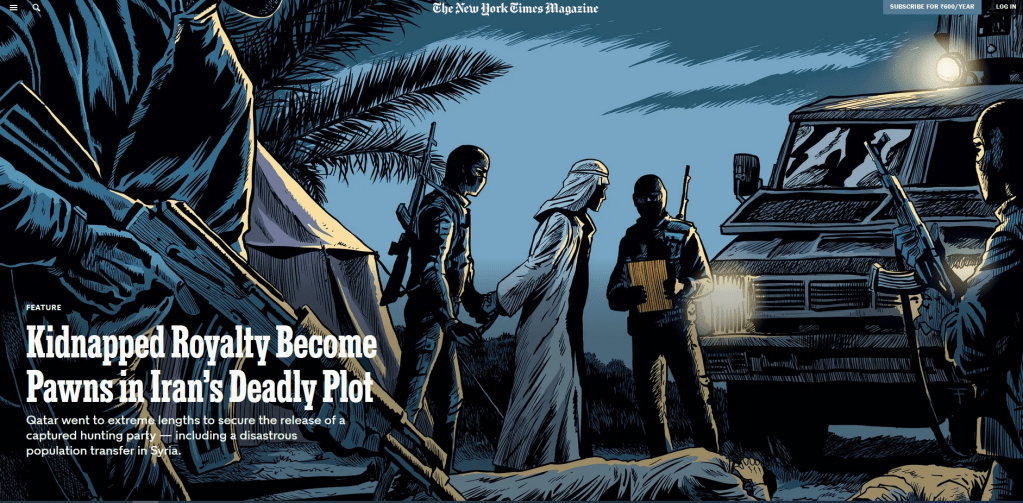
Next time you come across an image of an Arab with a falcon, I hope you ponder about it a bit more….
Discover more from Manish Mohandas
Subscribe to get the latest posts sent to your email.

One thought on “Falconry and the Arabs”